Part 1. Project 1. Exercise 5: Finding Out More

In this exercise I am to find two examples of still life work that includes fish and in each case note the title, artist and date. I am to make quick sketches of them in my learning log.

The two examples of still life including a fish which I chose to use are quite different from one another. The first is a photographic example which I found at The Guardian online.

the Guardian. (2019). The 10 best contemporary still lifes. [online] Available at: https://www.theguardian.com/culture/gallery/2013/oct/19/10-best-contemporary-still-lifes#img-10 [Accessed 17 Jul. 2019].
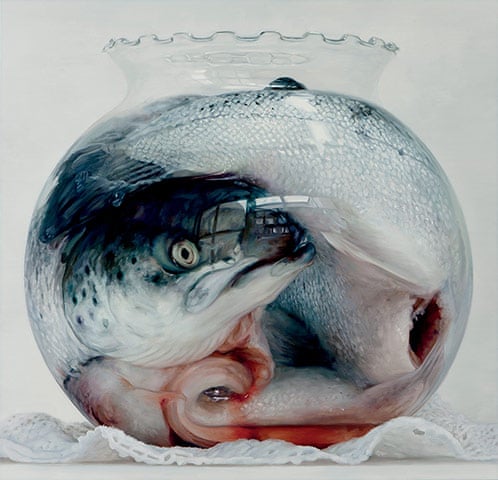
wright, c. (2010). Nature Morte 2. [image] Available at: https://www.theguardian.com/culture/gallery/2013/oct/19/10-best-contemporary-still-lifes#img-10 [Accessed 17 Jul. 2019].

This artist (Cindy Wright) has created a series of images to remind people about the cost of eating meat. All this image reminds me of are the needless displays of aggressive veganism at locations like Turkey farms and in the meat section of supermarkets. If we all had to kill our own meat then a lot of people may well choose to become vegetarian, personally I think that would depend entirely on how hungry people became. Everyone should know where their food comes from but equally there’s no need to dress it up. Again I find that this is an arrangement of objects to make a point but not something that I consider to be art.

My second choice of still life is an impressionist oil painting called Still Life with Fish by Pierre Auguste Renoir from 1890 which I discovered at WikiArt online.

http://www.wikiart.org. (2019). Still Life with Fish, c.1890 – Pierre-Auguste Renoir – WikiArt.org. [online] Available at: https://www.wikiart.org/en/pierre-auguste-renoir/still-life-with-fish [Accessed 17 Jul. 2019].
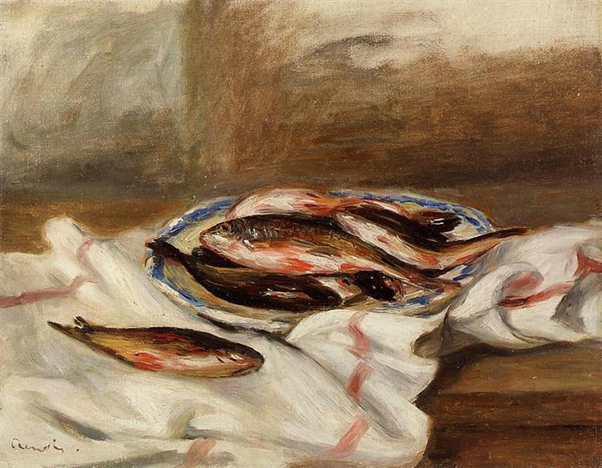
Renoir, P. (n.d.). [image] Available at: https://www.wikiart.org/en/pierre-auguste-renoir/still-life-with-fish [Accessed 17 Jul. 2019].

I do not think there are any hidden meanings in this image, I believe that it has been produced purely for decorative purposes. This, to me, is an example of art. It serves a purpose and it took a lot of skill to complete.

I now have to watch a video discussion from the Khan Academy about Hirsts piece. I am to list the different areas of context that are covered and any references to ‘time’.

I found this video, not at the link given in the student handout but instead at https://www.khanacademy.org/humanities/global-culture/beginners-guide-contemporary-art1/v/hirst-s-shark-interpreting-contemporary-art

Khan Academy. (2019). Damien Hirst, The Physical Impossibility of Death in the Mind of Someone Living. [online] Available at: https://www.khanacademy.org/humanities/global-culture/beginners-guide-contemporary-art1/v/hirst-s-shark-interpreting-contemporary-art [Accessed 17 Jul. 2019].

Areas of Context;

  • The title of the piece
  • Arts relationship to the understanding of mortality
  • Physical construction of the artwork
  • How open to interpretation art from the 20th and 21st century is
  • Survival instinct of the human brain
  • The disintegrating nature of the shark and how that can be a metaphor for normal life
  • The impermanence of art
  • The sophistication of Damien Hirst and the potential thought he put into the design of the piece
  • The establishment of museums of philosophy

References to Time;

  • favourite piece of art in last 3-4 decades
  • the history or art coming to terms with mortality
  • art through history
  • 20th and 21st century compared to renaissance
  • post the movie ‘Jaws’
  • 2nd shark that has been displayed in this tank
  • “his design didnt hold up to time”
  • transgenerational nature of art
  • art changing over time
  • Egyptians mummifying bodies
  • the inevitability of decay
  • museums as time capsules

Whilst listening I was also to listen out for information on several other headings;

  1. Hirst – It is decided that it was Hirsts ‘sophistication’ that led to him choosing to display the shark in a tank of formaldehyde. ‘He created the impossibility of its preservation’.
  2. The Piece – The title of the piece is remarked upon as being just as profound as the piece itself. The full experience is described as including both the piece AND the title.
  3. Hirsts other work – It is mentioned that he also slices sheep in half and displays them in tanks.
  4. Information on other artists whose work is concerned with mortality -Duchamp is quoted as saying “A work of art is completed by the viewer”. No other artists are mentioned.

Has the contextual information about The Physical Impossibility of Death in the Mind of Someone Living altered your view or response to it in any way?

Yes it has. My initial response to this installation was exasperation. Having read further online in essays previously referenced about the links between Hirst’s shark and capitalism through the decades I can now see how it represents a many layered message. I’ll certainly never be able to watch ‘Jaws’ in the same way again!

Even with my further enlightenment I still have not changed my definition on what makes something art. Having to go and research something to understand it, in my opinion, means something is unsuccessful as a concept.

The Guardian Article

I located this at https://www.theguardian.com/artanddesign/2012/apr/02/damien-hirst-tate-review.

Searle, A. (2019). Damien Hirst – review. [online] the Guardian. Available at: https://www.theguardian.com/artanddesign/2012/apr/02/damien-hirst-tate-review [Accessed 17 Jul. 2019].

Well I’ve read the article and I’m firmly on the side of the author. When I read that he had been classing Hirsts work as ‘memento mori in the pursuit of a reputation’ since 2009 I actually laughed aloud. I couldn’t agree more.

He assembles objects which provoke a reaction, yes. Unfortunately that reaction is normally one of disgust. Is it necessary to continually present once living things in tanks of formaldehyde? I am currently sat in the Falkland Islands where I am being forced to work with the Army. One of their favourite games at the moment is to try and poo on the floor in as public a place as possible without being caught. Seeing this mornings turd outside the hairdressers provoked a reaction in me all right but it certainly doesn’t make it art.

Part 1. Project 1. Exercise 3: Reading About Art

In this exercise I am required to read an excerpt from ‘Art History: The Basics’ by Grant Pooke and Diana Newall (2008, Abingdon: Routledge) Pages 1-8. I am to make notes on any parts that require further research or that jump out at me as particularly meaningful. I am also to identify any words that are new to me and list them.

The one item from this extract which really struck me was the initial tale of David Hensel submitting a sculputre of a head for an art exhibition, and how the plinth that accompanied it became mistakenly identified as the exhibit instead. That one of the traditional academy arts should be mistaken for a piece of Contemporary art strikes me as quite amusing.

I’m not a fan of Contemporary art myself so the idea that someone can look at an empty plinth and not think ‘maybe there’s something that should go on top of that’, just seems a bit nutty.

Throughout the text I noted down all words that were new to me. The words and their definitions are listed below.

Bauhaus – This is a German modern art movement.

My Modern Met. (2019). Bauhaus: How the Avant-Garde Movement Transformed Modern Art. [online] Available at: https://mymodernmet.com/what-is-bauhaus-art-movement/ [Accessed 17 Jul. 2019].

Hegemonic – This means leadership or dominance.

http://www.dictionary.com. (2019). Definition of hegemony | Dictionary.com. [online] Available at: https://www.dictionary.com/browse/hegemony [Accessed 17 Jul. 2019].

Ethnographic – This means ‘a branch of anthropology dealing with the scientific description of individual cultures ‘.  

http://www.dictionary.com. (2019). Definition of ethnographic | Dictionary.com. [online] Available at: https://www.dictionary.com/browse/ethnographic?s=t [Accessed 17 Jul. 2019]. Ethnographic – This means ‘ a branch of anthropology dealing with the scientific description of individual cultures ‘.

Part 1. Project 1. Reith Lectures – Grayson Perry

I was instructed to listen to at least one of and take notes on the Reith Grayson Perry lectures.

I found the transcripts online which proved to be very useful!

Reith Lectures – Tate Modern. (2013) Playing to the Gallery: Democracy has bad taste. https://www.bbc.co.uk/programmes/profiles/2dx4W4RjBBQ2JG2tqPbTl7r/how-to-watch-and-listen : (Accessed on 17 July 2019)

My notes on – Lecture One. Playing to the Gallery: Democracy Has Bad Taste

Contemporary art, once a bit of an eccentric niche, has gone mainstream, it’s all around us. A lot of people still aren’t comfortable with the idea of modern art and need more of a frame of reference with which to approach it which is what Grayson Perry (GP) wished to address.

There is a somewhat backward relationship between what we are told is good and what is actually popular. What is popular is different again to what we think we want, this was demonstrated by the experimentation of Komar and Melanie in the 1990’s. Currently something is only judged to be ‘of quality’ if deemed so by a range of different people from the artists peers to critics and dealers. After these inspections have taken place we are allowed to approach the ‘art’ knowing that this must be good. To me that defies the whole point of art, what’s right for one person is not right for another, if you happen to be in a minority of people for liking something then why should this mean that it is worth less, if, for you, it still takes your breath away?

Art takes itself very seriously as GP discovered when he was asked if he was a loveable character or a serious artist. The impression that the art world gives off is that you have to be high brow or your work is not worth as much, why? One example that springs to my mind is Banksy, an artist who regularly makes political statments through the use of representational elements in a very contemporary medium, admittedly a little illegally. His paintings are protected and auctioned for thousands which implies that he has passed the inspection phase that GP mentions by the curators, collectors and peers. Still though I do not see him feted in the art world for his talent, from what I have seen so far he seems to be an artist recognised and celebrated by the people rather than the experts.

This made me think twice about the title that GP gave this initial lecture. ‘Democracy has Bad Taste’. Does he mean that we, the great unwashed, have got no taste in what is art and what is not? Quite possibly it is instead a reference to the fact that what is deemed to be good by the experts can be at odds with what is actually popular. GP is a bit of an enigma in this interview both poking fun at the art worlds seriousness whilst simultaneously shuddering at the thought of fashionable people deciding that they like his art so I’m not sure which definition he would have been leaning towards.

In 1998 I watched the Turner Prize as recommended by my Art Teacher at the time. The winner that year was a man called Chris Ofili who uses a lot of elephant dung in his work to either adorn or support his paintings. Elephant dung. Now this guy must be classed as a good artist, he attended the Chelsea School of Art followed by the Royal College of Art in which time he was awarded a travelling scholarship around Zimbabwe (https://www.tate.org.uk/whats-on/tate-britain/exhibition/turner-prize-1998/turner-prize-1998-artists-chris-ofili Accessed 20/02/19) . On top of all that, he didn’t pull that Turner prize out of a cereal packet, he won it fair and square. It is the ‘how!?’ that blows my mind.

He’s attached poo to the painting of a black woman. If anybody else on the planet did that right now there would be outpourings of accusations of either racism or gender inequality. On top of that the painting doesn’t even look that good, to me, but as I’m sure is coming across I am one of the Great Unwashed who has no ‘taste’ in art and thinks Banksy is an inspiration. If that means I never have to look at a painting covered in elephant poo and look for deep significance within it then I’m ok with that to be honest!

Lecture Two. Playing to the Gallery: Beating the Bounds

Within this lecture GP sets out a criteria to help people decide whether or not something is art.

He also mentions an artist called Marcel Duchamp who brought a urinal into an independent art gallery in 1917 . Duchamp (GP says) believed that he could just point at something and say “That’s art”. I can’t believe that there was not a single person there who said to him “No mate, that is a urinal”, writing your name on something does not make it special. GP mentions further examples such as an artist (Robert Rauschenberg) who was asked to paint a portrait to which he wrote a response claiming an approximation of “this is a portrait if I say it is”, and this GP alleges is another work of art. No Mr Perry, that is someone being a tit.

As if his examples could not get any more hair-pullingly frustrating for their utter lack of hand skill, once again we are drawn back to excrement. It seems in 1961 an artist called Piero Manzoni canned his own faeces and sold them for their equivalent weight in gold.

*head in hands*

I listened to GP’s different litmus tests of whether or not something is a piece of art and came to the conclusion that he is actually one of the establishment of people he claims to poke fun at from afar.

Only one thing he mentioned in his lecture had any resonance with me. It was something he was told by Charlie Gere, Professor of Media Theory and History at Lancaster University. GP asked him ‘Can you give me a definition when I would know I was looking at a piece of web art rather than just an interesting website’. The reply was ‘you know it might be art rather than just an interesting website when it has the grip of porn without the possibility of consummation or a happy ending’. Now, ignoring the (once again) overly sordid frame of reference and applying it to art in general, that is the closest definition that I have found so far that correlates with my own opinion of what is and is not art.