I actually really enjoyed Assignment Five. Initially I struggled with locating a suitable textile to use as a subject piece, once I remembered about the existence of decades of strong national textile heritage it became a lot easier!
William Morris is a name I have heard bandied about for years on and off. I never really paid much attention bar the occasional eyebrow raising encounter with one of his incredible designs. It was fascinating to finally learn about his creative endeavours and life story.
The essay writing itself felt a lot easier than previous assignments, it was a case of trying to cut down on my typing rather than dredging up ideas to fill up a word count.
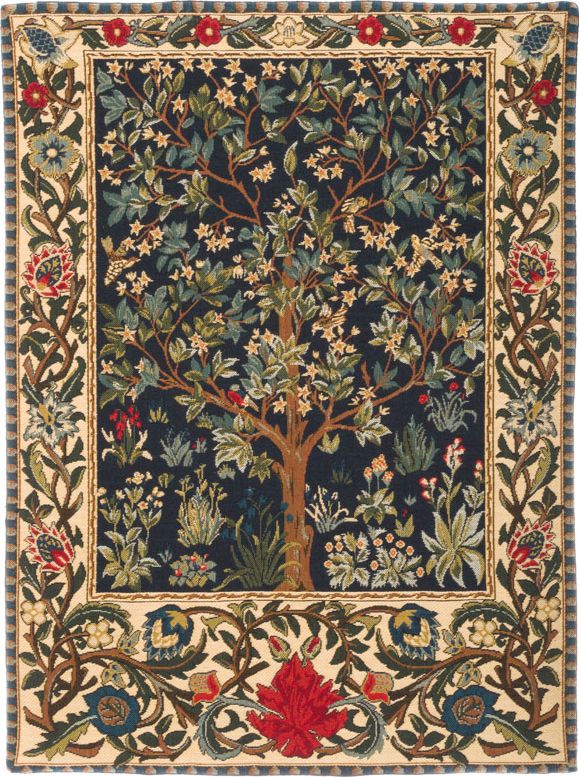
Looking at Morris’s work made me realise that quite a few artworks I have seen in films are inspired by him. One which stood out to me is below, the tapestry of the tree which in turn reminded me of the Black Family Tree from the Potter franchise.
It could be the similarity in the colour palette or simply the idea of a tree depicted in tapestry. Looking at it now I see simlarities in the sweeping lines of the leaves and branches of the two different pieces. Writing this has just given me an idea for the first exercise in Graphics 1….double win!
Overall, textiles has been an interesting module. I have learnt more from this module than the other four particularly about the wasteful nature of the fashion industry, that was eye opening. It was also encouraging to learn that artists such as Donna Wilson are able to find success with turning craft into business, and maintain the positive ethic values of that ideal throughout her operation.
My favourite exercise, besides the assignment, was in Part 1 in learning about the material life cycle. I learnt a lot from researching this area and will pay a lot more attention to where my clothes come from in future.
The exercise I found least enjoyable was researching Christian Boltanski’s installation ‘Personnes’ at the Grand Palais in Paris. Whilst I am aware that this will have been thought provoking and intriguing for many people, it’s just too morbid for my taste.
I would recommend this module to people who have no idea which specialised subjects they wish to study, also to those who are keen to learn more about thinking critically in relation to art. I would not recommend it to anyone with an engineering brain or who has low tolerance for understanding philosophical debate. I have learnt a lot from this module, my horizons have broadened and tolerance threshold has definitely increased, but I cannot honestly say I wouldn’t run away screaming if someone offered me a folder entitled Creative Arts 2.
My task in this Assignment is to identify an example of visual re appropriation within visual communication and analyse it in comparison to its original.
Following Tutor Feedback I redrafted this essay to contain a lot of the vital points which I had completely missed! These were; my reasons for choosing the Banksy, a lack of quotes to support my arguments, unqualified statements and the arguments for and against graffiti.
I have kept the original essay to make it easier for assessors to see where I have made changes, it is below this edited version and the references.
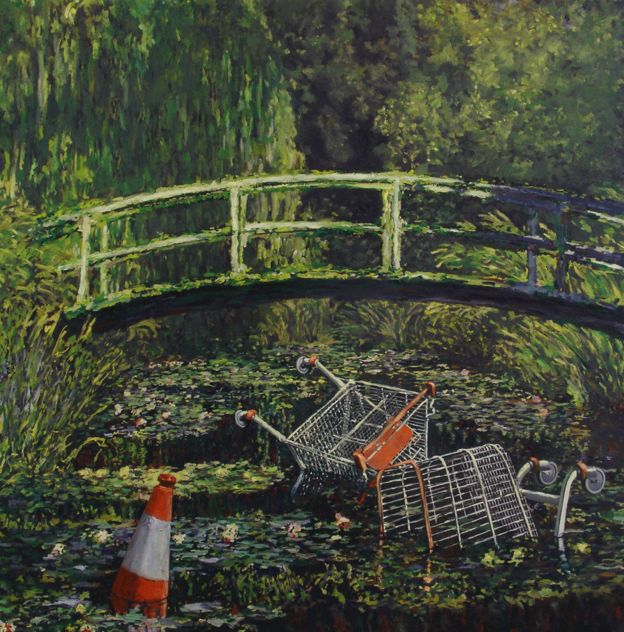
I chose to use a piece called ‘Show me the Monet’ by Banksy which I think will be a good fit for this exercise. I chose it because of the clear way in which Banksy has re appropriated a classic work to give a distinct message about consumerism, to my mind it meets the brief perfectly. In addition, I like both artists work so that didn’t hurt either! I think Monets green colour palette is very positive and calming whilst Banksys joyful approach to communicating his message always makes me laugh. It is the humour of his approach and the incredible skill levels of his work which I adore.
It is interesting that whilst most graffiti artists work is frowned upon and painted over, Banksys are sought after and can sell for millions. As with any artist there are those that hate his work and destroy it on sight, whilst others seek to protect it and give it recognition.
In my opinion, graffiti art needs more recognition. Within this genre though I would make a clear distinction between those who are actually making art and those who are just spraying their name on a wall. There are lots of excellent artists but what I believe sets Banksy apart are his political messages on current events. The humorous take on serious events combined with his excellent craft puts him in a league of his own.
Looking at the denotation of Monets original, I see a bridge suspended over a pond. The pond contains a variety of water lilies and is framed on the right by rushes and at the back by green trees. The suspended bridge acts as a top framing element to further focus the viewers eye on the lilies below.
When I consider the connotation of this image I keep returning to these lilies. I think this image is a celebration of the pond and its plants, I can not spot a deeper meaning to the image than this.
On researching a little I discovered that Monet was a passionate horticulturalist who brought some land near his house with the intention of building something ‘for the pleasure of the eye and for motifs to paint’. He first noticed the land when he was travelling through the village of Giverny on the train. He created his water lilies garden importing the plants from Egypt and South America despite the demands of the local council that he destroy them. In 1899 he began a series of paintings of it from different angles. Of the 18 paintings this is the one which I have seen most often displayed. (..I think…a lot of them are quite similar!)
He spent the last 30 years of his life painting his water garden even when he started to lose his sight to cataracts in 1912. After his death in 1926 the Lilies series remained in his Givency studio. It was 1955 before the Museum of Modern Art purchased their first image of the Lilies and it soon became their most well known attraction.
There are conflicting opinions on whether Monets series of lily paintings did or did not attract good press. According to Mentalfloss.com critics at the time argued that the impressionist style paintings were messy and blurred, however the webpage does not give further information on who these critics were. It was implied that this was because of the artists failing eyesight than a reflection of his painting style. Looking at an article from The Telegraph by Alastair Sooke in contrast it refers to Monet as the ‘prince of the Impressionists’ and a ‘figure of national importance’. These are not words I would associate with an artist who was being spurned.
Monets series of paintings is on display at various museums around the world. The painting ‘Bridge Over A Pond of Water Lilies’ is on display in The Met, Fith Avenue, New York City. I personally accessed it online and have never seen it in person. The nearest I have come to seeing a physical version of it is in Primary School when a teacher showed us a poster of a portion of one of the images of lilies. The invention of the Internet and its adoption by most people has opened up the world massively. I would never be so drawn to go and see Monets work that I would save for the years it would take to accumulate enough for the airfare to go and visit The Met in person. If the collection were to go on tour I doubt I would be able to get the correct day off work to go and see the exhibition when it reached the UK. But thanks to the Internet I can satisfy my curiosity and have a good look from the comfort of my own home. Because of the accessibility of art through the Internet, works can be seen and enjoyed by more people and therefore referenced in pop culture (as Banksy has done) to make a point which is understood.
The Banksy re-interpretation ‘Show Me The Monet’ shows the same scene of a bridge suspended over a pond full of water lilies. In this case though, the pond also features two discarded shopping trolleys and a traffic cone.
The images title ‘Show me the Monet’ can be interpreted in different ways. Banksy is a street artist known for creating art in public spaces where it can be widely viewed. He has frequently illicitly inserted his own versions of artwork into galleries but remains a prominently outdoor artist. In this sense, the title could be a reference to the fact that famous works are brought and kept by individual institutions. The additions of the trolleys and their symbolic reference to consumerism could be a more literal reference to money, an available play on words for Monet. Whichever it is, the more I look at different works by Banksy the more I notice that under his showman style of presentation he is a very intelligent artist with some very good points.
The shopping trolleys represent consumerism and the damage it is doing to nature. People are so obsessed with material gain that they disregard the fact they are killing the planet. I could not find reference to the initial showing of Show Me The Monet however I know that several of Banksys reimaginings of classical art were subversively planted in real gallerys such as the Louvre. I hope that this was one of them! I think this message that he wants to give with the art is fairly obvious.
Banksys work doesn’t just reference Monets original, it highlights its beauty in a whole new way. There are many images of beautiful landscapes but very few in which we can so directly see the negative effects that humans and our consumer society have on the planet. By using the same scene with the same component parts Banksys trolleys enhance the beauty of Monets waterscape with their sheer ugliness.
When Monet was alive and painting, people would produce paintings to raise awareness of beautiful things, to celebrate and document them. Banksys art is usually a social or political comment on a current situation. Where Monet would want to share the beauty of a particular scene, Banks wants us to realise how we are destroying them. Monets work is sought after and presented in galleries, Banksy sneaks into galleries and inserts his work (framed) for us to stumble across. Both artists are trying to make us aware of the same thing, beautiful places. It is just such a shame that people seem as determined to ignore it and not take action now in 2019 as they were back in 1899.
I think that using the same medium and style as Monet makes Banksys message even more striking. Famed for stencil art he could have easily made a stencil representation of this scene to illustrate the same message. In my opinion this would not have been so effective. By using the traditional painting of the original and incorporating the modern elements there is an added emphasis on the juxtaposed content.
There are several messages about consumerism here. There is the obvious message about peoples consumption without consideration, there is the irony of making that point by re appropriating an image that sells for $43M, and the further irony that anything Banksy touches also sells for vast sums. There are the further thoughts that it costs money to clean up our natural environment, and to do it voluntarily people need an incentive, often financial. The common message running through all these themes can be summed up wonderfully with Banksys title, to so many different people on so many levels ‘Show me the Monet!’.
Looking at the denotation of Monets original, I see a bridge suspended over a pond. The pond contains a variety of water lilies and is framed on the right by rushes and at the back by green trees. The suspended bridge acts as a top framing element to further focus the viewers eye on the lilies below.
When I consider the connotation of this image I keep returning to these lilies. I think this image is a celebration of the pond and its plants, I can not spot a deeper meaning to the image than this.
On researching a little I discovered that Monet was a passionate horticulturalist who brought some land near his house with the intention of building something ‘for the pleasure of the eye and for motifs to paint’. He first noticed the land when he was travelling through the village of Giverny on the train. He created his water lilies garden importing the plants from Egypt and South America despite the demands of the local council that he destroy them. In 1899 he began a series of paintings of it from different angles. Of the 18 paintings this is the one which I have seen most often displayed. (..I think…a lot of them are quite similar!)
He spent the last 30 years of his life painting his water garden even when he started to lose his sight to cataracts in 1912. After his death in 1926 the Lilies series remained in his Givency studio. It was 1955 before the Museum of Modern Art purchased their first image of the Lilies and it soon became their most well known attraction.
Originally Monets series of lily paintings did not attract good press. Critics at the time argued that the impressionist style paintings were messy and blurred. It was implied that this was because of the artists failing eyesight than a reflection of his painting style.
Monets series of paintings is on display at various museums around the world. The painting ‘Bridge Over A Pond of Water Lilies’ is on display in The Met, Fith Avenue, New York City. I personally accessed it online and have never seen it in person. The nearest I have come to seeing a physical version of it is in Primary School when a teacher showed us a poster of a portion of one of the images of lilies. The invention of the Internet and its adoption by most people has opened up the world massively. I would never be so drawn to go and see Monets work that I would save for the years it would take to accumulate enough for the airfare to go and visit The Met in person. If the collection were to go on tour I doubt I would be able to get the correct day off work to go and see the exhibition when it reached the UK. But thanks to the Internet I can satisfy my curiosity and have a good look from the comfort of my own home. Because of the accessibility of art through the Internet, works can be seen and enjoyed by more people and therefore referenced in pop culture (as Banksy has done) to make a point which is understood.
The Banksy re-interpretation ‘Show Me The Monet’ shows the same scene of a bridge suspended over a pond full of water lilies. In this case though, the pond also features two discarded shopping trolleys and a traffic cone.
The images title ‘Show me the Monet’ can be interpreted in different ways. Banksy is a street artist known for creating art in public spaces where it can be widely viewed. He has frequently illicitly inserted his own versions of artwork into galleries but remains a prominently outdoor artist. In this sense, the title could be a reference to the fact that famous works are brought and kept by individual institutions. The additions of the trolleys and their symbolic reference to consumerism could be a more literal reference to money, an available play on words for Monet. Whichever it is, the more I look at different works by Banksy the more I notice that under his showman style of presentation he is a very intelligent artist with some very good points.
The shopping trolleys represent consumerism and the damage it is doing to nature. People are so obsessed with material gain that they disregard the fact they are killing the planet. I could not find reference to the initial showing of Show Me The Monet however I know that several of Banksys reimaginings of classical art were subversively planted in real gallerys such as the Louvre. I hope that this was one of them! I think this message that he wants to give with the art is fairly obvious.
Banksys work doesn’t just reference Monets original, it highlights its beauty in a whole new way. There are many images of beautiful landscapes but very few in which we can so directly see the negative effects that humans and our consumer society have on the planet. By using the same scene with the same component parts Banksys trolleys enhance the beauty of Monets waterscape with their sheer ugliness.
When Monet was alive and painting, people would produce paintings to raise awareness of beautiful things, to celebrate and document them. Banksys art is usually a social or political comment on a current situation. Where Monet would want to share the beauty of a particular scene, Banks wants us to realise how we are destroying them. Monets work is sought after and presented in galleries, Banksy sneaks into galleries and inserts his work (framed) for us to stumble across. Both artists are trying to make us aware of the same thing, beautiful places. It is just such a shame that people seem as determined to ignore it and not take action now in 2019 as they were back in 1899.
I think that using the same medium and style as Monet makes Banksys message even more striking. Famed for stencil art he could have easily made a stencil representation of this scene to illustrate the same message. In my opinion this would not have been so effective. By using the traditional painting of the original and incorporating the modern elements there is an added emphasis on the juxtaposed content.
500 Word Commentaryabout Part Three
My main stoppers during this part of the course have been the trials and tribulations of my day job. During Part Three I’ve had to move to a new part of the country, rip out a kitchen and learn a new role so my study time has been even more disjointed than usual!
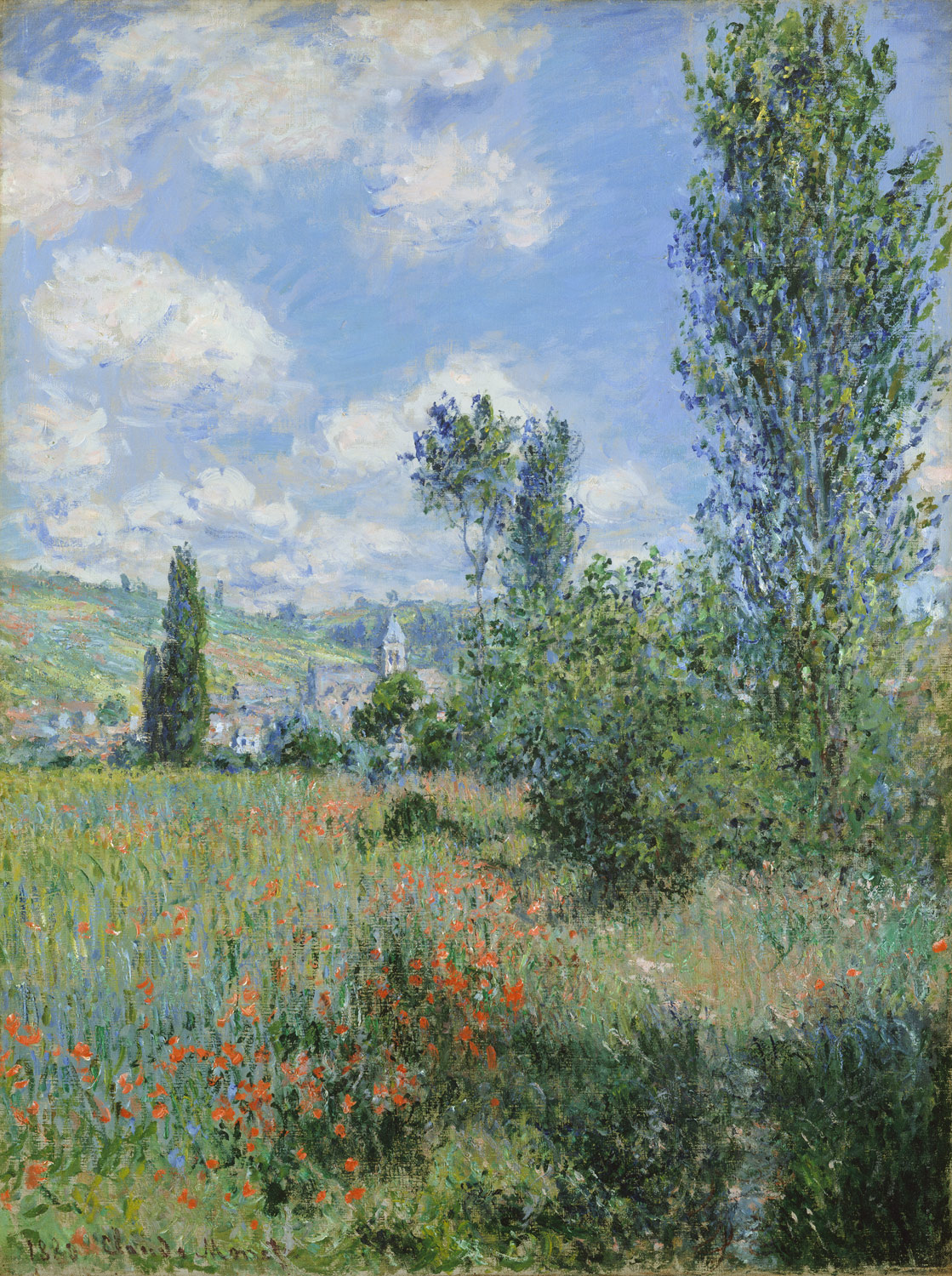
In terms of Part Three itself, the projects which most engaged my interest were Re-contextualizing Images, Mixed Messages and the Assignment itself. Im interested in the Graphic Design behind film and TV, so anything to do with fonts and typography I find interesting. I have always been interested in Photography (and Adobe Photoshop) so rearranging images in the Re-Contextualising Images exercise was a pleasure, especially with Boris Johnson as my main character, he is just so expressive! The Assignment was the most enjoyable of the lot. I always enjoy looking at Banksys work but too my surprise the more I looked into the work of Monets water lily project the more interested I became! This was due to the character of the artist and how his rebellious nature was described. I tend to imagine classic artists as being law abiding left wingers, not illegal plant smuggling border line obsessives! I was quite entertained! I’ve also started to gain a lot more interest in the original works of these art world Greats. Following tutor feedback I returned to this essay and looked at a lot more sources, some of Monets work really was breathtaking. One which particularly caught my eye was this View of Vetheuil. I like it because when displayed small on my browser window it looked almost photographic, then when I enlarged it, the full Impressionist approach revealed itself…I might even get a copy for my wall….
The exercise which I enjoyed the least was the very first one, ‘Identifying Visual Communications’. I fully understand and appreciate why it is required. It forces us to really get an understanding for the different types of visual communication and how it is everywhere. What grates on me is the length of if time-wise and having to prove every step with the image sourcing and referencing and then attempting to write notes on each image. This is consistently identified as one of my weaknesses and I fully concur. I know why I have to do it…I’m only bringing up this negative point because the course manual is asking me!
The manual also asks me if I am inspired to do further visual communications courses, I absolutely am. I continue to wish to complete this degree with Illustration and Graphic Design because I feel that they complement each other well. My ongoing overall inspiration are the Graphic Designers Eduardo Lima and Miraphora Mina who are the creative team behind the art of the Harry Potter/Fantastic Beasts franchises.
In this assignment I am to choose a piece of text by a contemporary author that explores time and/or place. I am then to carry out a close reading of it and write about my response, interpretation and feelings about the writing and its themes. I am also to mention: plot, structure, character, narrator, point of view, language and language techniques, as well as possible themes of time and place. (Word limit – 1500)
The Toymakers by Robert Dinsdale. Chapter 1 Page 1
The Emporium opens with the first frost of winter. It is the same every year.Across the city, when children wake to see ferns of white stretched across their windows, or walk to school to hear ice crackling underfoot, the whispers begin: the Emporium is open! Christmas is coming, and the goose is getting fat … If, at a certain hour on a certain winter night, you too had been wandering the warren between New Bond Street and Avery Row, you might have seen it for yourself. One moment there would be darkness, only the silence of shops shuttered up and closed for business. The next, the rippling snowflakes would part to reveal a mews you had not noticed before–and, along that mews, a storefront garlanded in lights. Those lights might be but pinpricks of white, no different to the snowflakes, but still they would draw your eye. Lights like these captivate and refract the darkness. Lights like these can bewitch the most cynical of souls. Watch out, because here one such soul comes, hurrying out of the night. He is a barrel of a man, portly to those who would look on him kindly, corpulent to those who would not. Outside the Emporium, he stops and gazes up, but this is not the first time he has been enchanted by these lights, so he steps through the door to be met by the whirlwind smells of cinnamon and star anise. Ribbons of navy blue stream apart and, in the vaulted ceiling above, miniature bells tinkle, spiriting up memories he has tried hard to forget: sleigh rides through parks too painful to remember, wassailing on the village green, Christmases in better, more innocent times. (Words 280)
This was an easy extract to choose for this exercise. I read a lot so am accustomed to good writing, even so, on reading this first page of ‘The Toymakers’ I was immediately entranced. I recall at the time actually noting how remarkably swiftly the author had constructed a sense of time and place. Months later on reaching this exercise in the course manual, I knew exactly which book to use.
The extract is longer than the instructions in the assignment, it proved to be awkward to edit down. The initial lines are essential to setting the season and atmosphere, the last few lines provide more depth to the character and situation, because of this I chose to keep both end of it and just use a longer extract.
The first theme which I notice in this extract is ‘Time’. The reader is immediately made aware that the narrative is set in a previous era, this is made clear in a variety of ways. The very first words of the extract, ‘The Emporium’, conjure up images of antiquity and discovery. Language choice as the passage continues, for example ‘first frost of Winter’, further this themes establishment. Word choices such as ‘mews’ ’emporium’ ‘garlanded’ and ‘corpulent’ are not in such common use anymore. They speak of an older era, possibly Victorian, it brings to mind the kind of architecture that is traditionally on the front of Christmas cards. It took me a while to figure out what Dinsdale had done with his approach to the language used. It didn’t seem to be old English, but at the same time, it is not as casual as the wording in contemporary novels. I eventually realised that he had just chosen to use correct English without any shortenings. For example, ‘It is the same every year’ vs ‘It’s the same every year’. This technique gives the whole text a flavour of coming from a different era but without alienating the modern reader. References to traditional Christmas elements such as the fattening of the goose, and ‘wassailing on the village green’ which are no longer mainstream all conspire to whisk the reader back to a world we quite often only see depicted on the front of Christmas cards.
Much like in the excerpt of The Road there is a man character who provides our focal point without actually being introduced to us or saying anything. The sense of ‘Time’ is so strong in this extract that by the time the character is introduced he comes automatically clothed (for me) in a long coat and a top hat. Possibly even clutching a walking cane he strides onto the scene so clearly that I can see it as if it were the opening shot of a film. Dressed as he is as in something you would expect from the Edwardian/Victorian era, this brings me to the second strong theme in this extract, ‘Place’.
We are given a location, ‘the warren between New Bond Street and Avery Row’, which to most readers will say ‘London’. A maze of streets, dark, full of swirling snow, this is an easy thing to ask a reader to picture. We can already imagine walking through the snow having been primed by the authors previous mention of ‘ice crackling underfoot’. As we, with the character described, see the lights garlanding our destination we are even told how they make us feel, how they draw us in. This is a clever use of language to manipulate the readers engagement and something which it took me quite a few read-throughs to notice. The lights are mentioned four times within four consecutive sentences. this intentional repetition reinforces the visualisation.
The third theme which I noticed is ‘Emotion’. At the start of the extract the author begins to remind us of the excitement that is felt in the run-up to Christmas. Most people have happy recollections of Christmas no-matter what their individual variation of it actually looks like. By staying traditional and generic with his use of festive references Dinsdale allows every reader to interpret these emotional triggers with their own details. When I was small we never had a goose, and my parents routinely chose the more practical approach of cooking a mass of legs and breasts as opposed to a whole bird. Despite this the mere mention or sight of a goose roast dinner sends my inner child giddy at the prospect of Christmas and all it’s associated fun. All these early references are designed to trigger positive emotions. On sighting The Emporium with its garlands of light we are instructed on how to react, we are told that we are ‘captivated’, ‘bewitched’ and ‘drawn in’. Fairy lights are another traditionally cheerful festive association, town centres even hold events when the lights are officially switched on! It is at this point that Dinsdale introduces the contrast of the character and his emotions. Whereas the goose being described as getting fat was a positive association, the nameless man is described alternately as ‘a barrel’, ‘portly’ and ‘corpulent’. These are more negative word choices which lead into the direct contrast between the positive sights and smells of the Emporiums interior vs the negative Christmas memories that they trigger within the man.
Writing in the second person allows the narrative to further envelop the reader, it feels as though we are in the scene itself alongside the character. I think it is this factor which makes the scene so vivid for me personally. I feel like I could storyboard the beginning of this as a film quite easily. More generically the use of a second person narration allows the reader to focus on the sense of place being generated by the text, senses are stimulated through triggered memories. When these are positive memories there will be increased external buy-in. This in turn allows greater engagment when the character is introduced.
The juxtaposition of the positive Christmas atmosphere that Dinsdale has created with someone who seems to have negative attitudes towards it is designed to intrigue, what has happened to this character that he can not only withstand the positive triggers which we the reader are subjected too, but further, can give them a negative overtone? Although in such a short extract there can be no real sense of the plot of the story, the building structure of the opening has already given the reader something to discover, the reason for the mans negativity and hopefully, the pathway to his recovery.
I find Dinsdales writing, specifically the way he can create such immersive scenes, utterly enchanting. The themes are explored alongside the plot allowing the reader to pay as much attention to them as they choose. When I initially read this book I was concentrating purely on the plot line, but having completed this Part 2 of the Creative Arts Today module, and having learnt so much about particularly The Heroes Journey and poetic devices, I will certainly be reading it again soon!
Word count: 1,137
Dinsdale,R. Published 08 Feb 2018. The Toymakers. Penguin Books. United Kingdom.
Part Two
To conclude I am to write a commentary of about 500 words, drawn from my learning log and notes, reflecting on what I have learned in this part of the course and how I have put this into practice in my assignment piece.
The main thing that I have taken from this part of the module has been a greater awareness of poetic devices. I had always just assumed that poetic devices were restricted to poems themselves, now that various exercises have pointed out to me quite how obviously they are used in a variety of applications I am surprised that I have never noticed them before!
I was also intrigued to learn about how many different sort of poetic device there are and how they are key to constructing a good narrative within a novel. Since working through this module I have become more aware of what I am reading and how it has been constructed, this in turn has heightened my enjoyment of the text because now I can identify why I am finding it so immersive. Using this knowledge I was able to return to the extract of text and find a new level of appreciation for the skill with which it has been put together.
I was also surprised at how poetic some extracts of novels are when taken in isolation. I’ve never particularly liked poems, I’ve always thought of them as pointless, following this section of the module this is an opinion which I will have to re-visit.
A skill which I have learnt from this module is that of analysis or close reading. Trying to spot the different poetic devices felt like quite an enjoyable game and I’ve found myself looking for them in other items that I have been reading. It’s assisted me in identifying why I find some authors good and others not to my taste. Having learnt to carry out close reading I spent some time studying the extract properly and highlighting all the uses of poetic device that I could identify. I used the same technique to pick out where the different themes were introduced and incorporated.
When I’d successfully identified them I was able to establish a hierarchy and look for what I believe the author wanted to make most prominent. The themes of time and place were most prominent which would fit with the start of a novel. The most important thing is to establish a scene for a reader and immerse them within it before introducing the action.
I also found it interesting how much an author can say about a character without the reader knowing basic information such as a name or having witnessed any conversation. The extract from ‘The Road’ in Project 4 introduces the reader to a man and boy and through narrative device ensures that the reader forms impressions about them whilst knowing very little. This is another thing that I had never noticed before but will certainly learn from and use in my own work.
My views on what art is have definitely
changed a bit. I can now see that something doesn’t have to be a physical image
to stimulate imagination or recreate a sensation. I’ve racked my brain
attempting to find a word to categorise Contemporary pieces as something
different but have come to the conclusion that as much as I dislike it, it is art. Whereas my own tastes have not
changed I can now see that whereas I prefer a physical rendition of an image
and take stimulation from that, for other people the image is not needed. They
only need or want to be stimulated in a certain direction and to fill in the
gaps for themselves.
As a result of completing Part One I have learnt several things. I have
learnt that popularity is not a guarantee of quality, attention can be drawn to
items because of their shock value rather than their skill content. I have
learnt the value of looking at lots of different sources to find a range of
opinions on the same topic. I have also learnt that there are a lot more
sources of information on the internet that I should be consulting than I had
previously realised. With this, the value of ascertaining whether the source is
Primary or Secondary has also become more obvious to me.
Bearing in mind my limitations resource-wise (sat on a military outpost in the Antarctic Circle with limited internet) I think my Learning Log is progressing quite well. Currently it suffers from lack of external material such as postcards, and I am not capable of getting to any exhibitions. I am attempting to remedy this by exploring collections of work online. It could be improved by more research, there is always room for more research! I think my learning about Contemporary Art could also be improved by more exploration of somewhere like the Tate Modern, ideally in person. Another lesson I have picked out to take with me is the power of suggestion. Until now I have always striven to provide an entire message within an image, experimenting with leaving the interpretation a little more open to the viewer is something which could be interesting to explore.
Part B
Interpret
Jeremy Deller’s Battle of Orgreave and reflect on the importance of time and
place in this piece. Write 800-1000 words.
Post Tutor Feedback
My tutor made many excellent points in post-assignment feedback, some of which I wish to incorporate into the essay prior to submission for assessment. These are;
giving the reasons that I disagree with Jones comparison to a Renaissance painting
countering my own view by presenting both sides of the argument
adjusting my remarks about the job of the military vs the police
make my essay less of a political statement about status quo and refocus on Dellers interpretation of Orgreave
adddress whether I consider Deller to have told the truth/have a bias/have an opinion
Below is the text of my revisited essay, following that are my references and then the original essay to allow easy comparison.
Revisited Essay
In this essay I am going to interpret Jeremy Deller’s work ‘Battle of Orgreave’ and reflect on the importance of time and place within the piece.
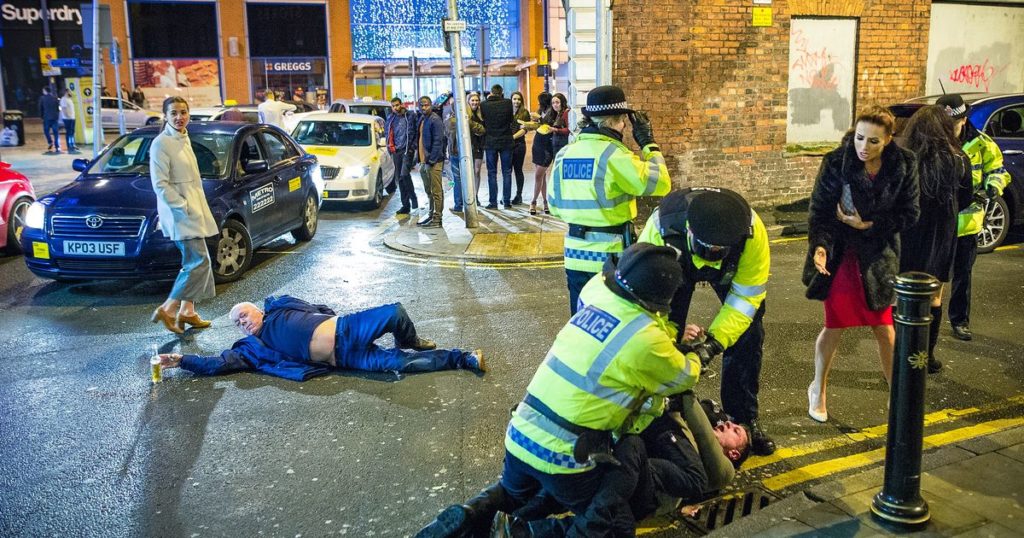
Having read about some of Dellers ideas for projects in the Guardian article (https://www.theguardian.com/culture/2001/jun/19/artsfeatures), particularly the Northern brass band playing acid house tunes, I am not sure that even the artist thought that his proposal would be accepted by Artangel. Initially I was doubtful about whether enactment could be classed as an art. In his article for the Guardian newspaper journalist Jonathon Jones makes the case that the placement of members of the cast in various scenarios resembles a Renaissance painting, a reflection of Dellers education in Art History in which he specialised on the Baroque. I disagree with the comparison to the old masters because I do not see any particular conventions adhered too or familiar groupings of characters. However I do see that this re-enactment, and the emotions it would provoke in the onlookers does fit my new found definition for Contemporary Art as I described in Part A. There is one photograph which sprang to mind at the Renaissance reference. In another Guardian article. https://www.theguardian.com/uk-news/2016/jan/03/like-a-beautiful-painting-image-of-new-years-mayhem-in-manchester-goes-viral)
This photograph taken by chance by Joel Goodman on Wells Street in Manchester on New Years Eve 2015, became famous for it’s characters positioning and accidental adherence to the Fibonacci Spiral. Whilst considering this photograph I realised that there could be many different angles to Deller’s composition. By using reenactors he allows people not just to see the art through the medium of photographs or pictures, but also to experience it, to live it. It would be the equivalent of stepping inside a historical film on tv.
The importance of time if the piece is apparent in many ways. In practical terms the co-ordination, literally the timing, of so many reenactors to recreate so many previously recorded events would have been a mammoth undertaking. The timing of the re-enactment, approximately 20 years after the actual event, links the events of Orgreave with a new generation. Something that the young people of the area would only have heard about from their parents would be made real for them providing a shared experience. Reenacting events with participants from the original ‘battle’ could also potentially give them the opportunity to readdress their bias of the time. Often strongly held beliefs can colour recollection of events. The choice to have the reenactors in historically accurate costume set against the backdrop of modern Orgreave shows the passage of time in several ways. Most obviously this will be illustrated in the fashion of the different eras but also in the rejuvenation of the area since the 80’s and the strikes.
As described in ‘Place’ by Dean and
Millar (page 14) ‘many important historical events are now known simply by the
place in which they occurred’, or as James Joyce in a preparatory note to
Ulysses wrote, ‘places remember events’. Normally this refers more to events
such as Hiroshima which shaped the course of human conflict, but, on a more
local scale, the same can be said of Orgreave. The re-enactment had to be staged in Orgreave, the action
and the location are the two essential elements that give the event meaning.
Taking the action and playing it elsewhere would not make any sense and vice
versa.
I find that the messages that come out of the combined art experience, the re-enactment and the subsequent installations are mostly inflammatory and anti-establishment. Being in the military myself also gives me a particular view on the event and therefore the messages I receive from the reconstruction. The main job of the military is to fight the enemy and win, the main job of the police is to protect the people. If the military are instructed to act as the police, the people become the enemy and that would have lead to even worse confrontations, therefore it was not the military the Unions organised gangs had to deal with. The miners were breaking the law, the police acted accordingly and were met with heavy resistance. If the miners had dispersed as any law abiding citizen should, then Orgreave would never have happened. What frustrates me so severely is that when they chose to escalate the action and fight the police everyone acts so surprised that various officers ‘lost it’ and violent incidents ensued. The police are law keepers and people protectors, they’re not superhumans and they’re not trained for warfare. The message that in my opinion the installations are giving of some noble call to arms by the ‘victimised’ miners being quashed by the thuggish autocratic state is utterly ridiculous. The video on www.jeremydeller.org showing clips of the re-enactment footage alongside the original event footage serves only to reinforce the divisions in a society which for a few, may have finally started to fade with time.
The signature scene is of the miners being chased by a police cavalry charge, I think this is supposed to shock the viewer. Quite how else people imagine that rioters can be cleared out of a built up area to both contain the violence they are responsible for and protect everyone else is beyond me. In my opinion Deller has reawakened a ghost in Orgreave. The pits had to close, as it says in ‘Place’ Pages 106-107 global capitalism dictated that local identity had to be sacrificed for the international trade in commodities. It was devastating for the communities involved but it made financial sense for the country.
The recreation of events cannot be classed as having a bias, they were recorded at the time, however I heavily question the way Deller has presented them. From my experience of the exhibition, the bias of the presentation is anti-establishment so in my opinion Deller cannot be classed as a neutral party reawakening history.
Deller has thoroughly but needlessly made fresh the arguments from both sides, I would rather have seen him spend Artangels commission on the Northern brass bands playing acid house music.
In this essay I am going to interpret Jeremy Deller’s work ‘Battle of Orgreave’ and reflect on the importance of time and place within the piece.
Having read about some of Dellers ideas for projects in the Guardian article (https://www.theguardian.com/culture/2001/jun/19/artsfeatures), particularly the Northern brass band playing acid house tunes, I am not sure that even the artist thought that his proposal would be accepted by Artangel. Initially I was doubtful about whether enactment could be classed as an art. In his article for the Guardian newspaper journalist Jonathon Jones makes the case that the placement of members of the cast in various scenarios resembles a Renaissance painting, a reflection of Dellers education in Art History in which he specialised on the Baroque. I disagree with the comparison to the old masters but I do see that this re-enactment, and the emotions it would provoke in the onlookers, does fit my new found definition for Contemporary Art as I described in Part A. There is one photograph which sprang to mind at the Renaissance reference. In another Guardian article. https://www.theguardian.com/uk-news/2016/jan/03/like-a-beautiful-painting-image-of-new-years-mayhem-in-manchester-goes-viral)
This photograph taken by chance by Joel Goodman on Wells Street in Manchester on New Years Eve 2015, became famous for it’s characters positioning and accidental adherence to the Fibonacci Spiral. Whilst considering this photograph I realised that there could be many different angles to Deller’s composition. By using reenactors he allows people not just to see the art through the medium of photographs or pictures, but also to experience it, to live it. It would be the equivalent of stepping inside a historical film on tv.
The importance of time if the piece is
apparent in many ways. In practical terms the co-ordination, literally the timing,
of so many reenactors to recreate so many previously recorded events would have
been a mammoth undertaking. The timing of the re-enactment, approximately 20 years
after the actual event, links the events of Orgreave with a new generation.
Something that the young people of the area would only have heard about from
their parents would be made real for them providing a shared experience. The
choice to have the reenactors in historically accurate costume set against the
backdrop of modern Orgreave shows the passage of time in several ways. Most
obviously this will be illustrated in the fashion of the different eras but
also in the rejuvenation of the area since the 80’s and the strikes.
As described in ‘Place’ by Dean and
Millar (page 14) ‘many important historical events are now known simply by the
place in which they occurred’, or as James Joyce in a preparatory note to
Ulysses wrote, ‘places remember events’. Normally this refers more to events
such as Hiroshima which shaped the course of human conflict, but, on a more
local scale, the same can be said of Orgreave. The re-enactment had to be staged in Orgreave, the action
and the location are the two essential elements that give the event meaning.
Taking the action and playing it elsewhere would not make any sense and vice
versa.
I find that the messages that come out of the
combined art experience, the re-enactment and the subsequent installations are
mostly inflammatory and anti-establishment. Being in the military myself also
gives me a particular view on the event and therefore the messages I receive
from the reconstruction. The job of the military is to fight the enemy and win,
the job of the police is to protect the people. If the military are instructed to act as the
police, the people become the enemy and that would have lead to even worse
confrontations, therefore it was not the military the Unions organised gangs
had to deal with. The miners were breaking the law, the police acted
accordingly and were met with heavy resistance. If the miners had dispersed as
any law abiding citizen should, then Orgreave would never have happened. What
frustrates me so severely is that when they chose
to escalate the action and fight the police everyone acts so surprised that
various officers ‘lost it’ and violent incidents ensued. The police are law
keepers and people protectors, they’re not superhumans and they’re not trained
for warfare. The message that the
installations seem to be giving of some noble call to arms by the
‘victimised’ miners being quashed by the thuggish autocratic state is utterly
ridiculous. The video on www.jeremydeller.org showing clips of the re-enactment
footage alongside the original event footage serves only to reinforce the
divisions in a society which for a few, may have finally started to fade with
time.
The signature scene is of the miners being
chased by a police cavalry charge, I think this is supposed to shock the
viewer. Quite how else people imagine that rioters can be cleared out of a
built up area to both contain the violence they are responsible for and protect
everyone else is beyond me.
In my opinion Deller
has reawakened a ghost in Orgreave. The pits had to close, as it says in ‘Place’ Pages 106-107 global capitalism
dictated that local identity had to be sacrificed for the international trade
in commodities. It was devastating for the communities involved but it made
financial sense for the country. The Unions had to be broken, no organisation
can be allowed to hold the Government to ransom otherwise civil wars won’t be a
matter of re-enactment, they’ll be on the streets outside your front door and
the first person you’ll be wanting to turn up is a policeman. Deller has thoroughly
but needlessly made fresh the arguments from both sides, I would rather have
seen him spend Artangels commission on the Northern brass bands playing acid
house music.


 Creative Arts Today