Part 5. Project 3. Research Point – Wrapped Trees etc

In this exercise I am to look at a project called ‘Wrapped Trees’, then, a series of example exhibitions as detailed in the course manual.

Surrounded IslandsChristo and Jeanne-Claude

Surrounded Islands, Biscayne Bay, Greater Miami, Florida, 1980-83
Christojeanneclaude.net. (2019). [online] Available at: https://www.christojeanneclaude.net/__data/605bf1a7335940611b138ff04723ef50.jpg [Accessed 16 Dec. 2019].

In 1983 two artists (Christo and Jeanne-Claude) surrounded eleven islands with 6.5 million square feet of floating pink woven polypropylene. According to their website they did this to  ‘underline the various elements and ways in which the people of Miami live, between land and water.

At a guess I would assume that they did this so that people could view their artwork from different angles and through different methods. Flying over it might give a different message from approaching it on the causeway which would be different again to approaching it by boat. It would certainly be classed as a piece of land art on the scale that it interacts with its environment.

The course manual asks me if I agree with the given analysis. I do, but then I find the analysis very factual, facts are hard to disagree with! “Surrounded Islands sees textiles used on an extremely large scale to both define and cover aspects of the natural environment”, in response to that I think that they have certainly used a lot of fabric, the fabric is sewn to highlight the contours of the island….and it’s covering the water….so yes?!

Wrapped Trees Christo and Jeanne-Claude

Wrapped Trees, Fondation Beyeler and Berower Park, Riehen, Switzerland, 1997-98
Christojeanneclaude.net. (2019). [online] Available at: https://www.christojeanneclaude.net/__data/6fb9229e8c4acbaa867cf94610acaa71.jpg [Accessed 16 Dec. 2019].

Wrapped Trees took place in Germany in 1998. Approximately 178 trees were wrapped in 592,015 square feet of woven polyester fabric. This is apparently a technique used by the Japanese to protect trees from heavy snow each winter.

The course manual instructs me to respond to the following quote from the point of view of the textile rather than the trees;

“The ‘wrapping’ is NOT at all the common denominator of the works. What is really the common denominator is the use of fabric, cloth, textile. Fragile, sensuous and temporary materials which translate the temporary character of the works of art.”

To be honest I’m stumped. I understand that the fabric will blow with the wind and that the tree within will contort it into different shapes, I suspect that there is probably a statement in there somewhere about mans interaction/control with the landscape. But try as I might I just do not understand why someone would want to bag up a tree. So confused.

Yayoi Kusama – Infinity Mirrored Room 1998

Image result for yayoi kusama infinity mirrored room 1998
Phaidon. (2019). The fantastical world of Yayoi Kusama | Art | Agenda | Phaidon. [online] Available at: https://uk.phaidon.com/agenda/art/picture-galleries/2012/february/02/the-fantastical-world-of-yayoi-kusama/ [Accessed 16 Dec. 2019].

Art or Design

Temporary or Permanent

Large Scale or Small Scale

Transforming and/or Defining and/or Forming

Immersive and/or Distant

Pattern and/or Colour and/or Repetition and/or Shape

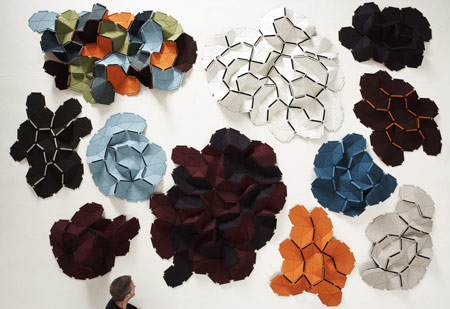
Ronan and Erwan Bouroullec – Clouds

clouds-by-ronan-and-erwan-bouroullec-6.jpg
Static.dezeen.com. (2019). [online] Available at: http://static.dezeen.com/uploads/2009/01/clouds-by-ronan-and-erwan-bouroullec-6.jpg [Accessed 16 Dec. 2019].

Art or Design

Temporary or Permanent

Large scale or Small scale

Transforming and/or Defining and/or Forming

Immersive and/or Distant

Pattern and/or Colour and/or Repetition and/or Shape

Marianne Straub – Moquette Textile 1970

Colour transparency, C69 stock Circle line train, interior view by Dr Heinz Zinram, 2 June 1970
Images.ltmuseum.co.uk. (2019). [online] Available at: https://images.ltmuseum.co.uk/images/max/25/015225.jpg [Accessed 16 Dec. 2019].

Images.ltmuseum.co.uk. (2019). [online] Available at: https://images.ltmuseum.co.uk/images/max/25/015225.jpg [Accessed 16 Dec. 2019].

I was a bit miffed to see the upholstery for underground trains turn up in this exercise. I want to use them for my Assignment at the end of this module and thought I’d come up with an idea that was a bit unique!

Art or Design

Temporary or Permanent

Large scale or Small scale

Transforming and/or Defining and/or Forming

Immersive and/or Distant

Pattern and/or Colour and/or Repetition and/or Shape

Static.dezeen.com. (2019). [online] Available at: http://static.dezeen.com/uploads/2009/01/clouds-by-ronan-and-erwan-bouroullec-6.jpg [Accessed 16 Dec. 2019].

events, F., CollectionsCollections online The collection Stories Vehicles Posters Photographs People Sound recordings Uniforms Archives Drawings Equipment Infrastructure Maps Ephemera Vehicle parts Artwork Models Library Relics Signs Technical documents Tickets Timetables Film & Video Projects and partnerships Battle Bus Edward Johnston Frank Pick Moquette Project Where are all the women? District 150 Q stock restoration LGBT+ collecting Depot Discovery Rail vehicles Road vehicles Engineering and technology Design and environment Maps, f., Depot Discovery Rail vehicles Road vehicles Engineering and technology Design and environment Maps, f., Maps, s., Photography, f., blog, M., partnerships, C., partnerships, P., Friends, L., members, C. and members, C. (2019). Photographs. [online] Ltmuseum.co.uk. Available at: https://www.ltmuseum.co.uk/collections/collections-online/photographs/item/2001-5225?&apiurl=aHR0cHM6Ly9hcGkubHRtdXNldW0uY28udWsvYWxsP3Nob3J0PTEmc2tpcD0wJmxpbWl0PTQ4JnE9c3RyYXVi [Accessed 16 Dec. 2019].

Etherington, R. (2019). Clouds by Ronan and Erwan Bouroullec | Dezeen. [online] Dezeen. Available at: https://www.dezeen.com/2009/01/16/clouds-by-ronan-and-erwan-bouroullec/ [Accessed 16 Dec. 2019].

Phaidon. (2019). The fantastical world of Yayoi Kusama | Art | Agenda | Phaidon. [online] Available at: https://uk.phaidon.com/agenda/art/picture-galleries/2012/february/02/the-fantastical-world-of-yayoi-kusama/ [Accessed 16 Dec. 2019].

CBC. (2019). 12 places where you can find a Yayoi Kusama Infinity Mirror Room right now | CBC Arts. [online] Available at: https://www.cbc.ca/arts/12-places-where-you-can-find-a-yayoi-kusama-infinity-mirror-room-right-now-1.4893108 [Accessed 16 Dec. 2019].

Artribune. (2019). Kusama mania | Artribune. [online] Available at: https://www.artribune.com/report/2011/11/kusama-mania/ [Accessed 16 Dec. 2019].

BBC. (2019). BBC Arts – BBC Arts – Wrap stars: Christo and Jeanne-Claude’s 50 years of pop-up art. [online] Available at: https://www.bbc.co.uk/programmes/articles/2LFSrLK9XjRxLqTRNdftLqd/wrap-stars-christo-and-jeanne-claudes-50-years-of-pop-up-art [Accessed 16 Dec. 2019].

Christojeanneclaude.net. (2019). Projects | Surrounded Islands. [online] Available at: https://www.christojeanneclaude.net/projects/surrounded-islands [Accessed 16 Dec. 2019].

Christojeanneclaude.net. (2019). [online] Available at: https://www.christojeanneclaude.net/__data/6fb9229e8c4acbaa867cf94610acaa71.jpg [Accessed 16 Dec. 2019].
Assignment Two

In this assignment I am to choose a piece of text by a contemporary author that explores time and/or place. I am then to carry out a close reading of it and write about my response, interpretation and feelings about the writing and its themes. I am also to mention: plot, structure, character, narrator, point of view, language and language techniques, as well as possible themes of time and place. (Word limit – 1500)

The Toymakers by Robert Dinsdale. Chapter 1 Page 1

The Emporium opens with the first frost of winter. It is the same every year. Across the city, when children wake to see ferns of white stretched across their windows, or walk to school to hear ice crackling underfoot, the whispers begin: the Emporium is open! Christmas is coming, and the goose is getting fat … If, at a certain hour on a certain winter night, you too had been wandering the warren between New Bond Street and Avery Row, you might have seen it for yourself. One moment there would be darkness, only the silence of shops shuttered up and closed for business. The next, the rippling snowflakes would part to reveal a mews you had not noticed before–and, along that mews, a storefront garlanded in lights. Those lights might be but pinpricks of white, no different to the snowflakes, but still they would draw your eye. Lights like these captivate and refract the darkness. Lights like these can bewitch the most cynical of souls. Watch out, because here one such soul comes, hurrying out of the night. He is a barrel of a man, portly to those who would look on him kindly, corpulent to those who would not. Outside the Emporium, he stops and gazes up, but this is not the first time he has been enchanted by these lights, so he steps through the door to be met by the whirlwind smells of cinnamon and star anise. Ribbons of navy blue stream apart and, in the vaulted ceiling above, miniature bells tinkle, spiriting up memories he has tried hard to forget: sleigh rides through parks too painful to remember, wassailing on the village green, Christmases in better, more innocent times. (Words 280)

This was an easy extract to choose for this exercise. I read a lot so am accustomed to good writing, even so, on reading this first page of ‘The Toymakers’ I was immediately entranced. I recall at the time actually noting how remarkably swiftly the author had constructed a sense of time and place. Months later on reaching this exercise in the course manual, I knew exactly which book to use.

The extract is longer than the instructions in the assignment, it proved to be awkward to edit down. The initial lines are essential to setting the season and atmosphere, the last few lines provide more depth to the character and situation, because of this I chose to keep both end of it and just use a longer extract.

The first theme which I notice in this extract is ‘Time’. The reader is immediately made aware that the narrative is set in a previous era, this is made clear in a variety of ways. The very first words of the extract, ‘The Emporium’, conjure up images of antiquity and discovery. Language choice as the passage continues, for example ‘first frost of Winter’, further this themes establishment. Word choices such as ‘mews’ ’emporium’ ‘garlanded’ and ‘corpulent’ are not in such common use anymore. They speak of an older era, possibly Victorian, it brings to mind the kind of architecture that is traditionally on the front of Christmas cards. It took me a while to figure out what Dinsdale had done with his approach to the language used. It didn’t seem to be old English, but at the same time, it is not as casual as the wording in contemporary novels. I eventually realised that he had just chosen to use correct English without any shortenings. For example, ‘It is the same every year’ vs ‘It’s the same every year’. This technique gives the whole text a flavour of coming from a different era but without alienating the modern reader. References to traditional Christmas elements such as the fattening of the goose, and ‘wassailing on the village green’ which are no longer mainstream all conspire to whisk the reader back to a world we quite often only see depicted on the front of Christmas cards.

Much like in the excerpt of The Road there is a man character who provides our focal point without actually being introduced to us or saying anything. The sense of ‘Time’ is so strong in this extract that by the time the character is introduced he comes automatically clothed (for me) in a long coat and a top hat. Possibly even clutching a walking cane he strides onto the scene so clearly that I can see it as if it were the opening shot of a film. Dressed as he is as in something you would expect from the Edwardian/Victorian era, this brings me to the second strong theme in this extract, ‘Place’.

We are given a location, ‘the warren between New Bond Street and Avery Row’, which to most readers will say ‘London’. A maze of streets, dark, full of swirling snow, this is an easy thing to ask a reader to picture. We can already imagine walking through the snow having been primed by the authors previous mention of ‘ice crackling underfoot’. As we, with the character described, see the lights garlanding our destination we are even told how they make us feel, how they draw us in. This is a clever use of language to manipulate the readers engagement and something which it took me quite a few read-throughs to notice. The lights are mentioned four times within four consecutive sentences. this intentional repetition reinforces the visualisation.

The third theme which I noticed is ‘Emotion’. At the start of the extract the author begins to remind us of the excitement that is felt in the run-up to Christmas. Most people have happy recollections of Christmas no-matter what their individual variation of it actually looks like. By staying traditional and generic with his use of festive references Dinsdale allows every reader to interpret these emotional triggers with their own details. When I was small we never had a goose, and my parents routinely chose the more practical approach of cooking a mass of legs and breasts as opposed to a whole bird. Despite this the mere mention or sight of a goose roast dinner sends my inner child giddy at the prospect of Christmas and all it’s associated fun. All these early references are designed to trigger positive emotions. On sighting The Emporium with its garlands of light we are instructed on how to react, we are told that we are ‘captivated’, ‘bewitched’ and ‘drawn in’. Fairy lights are another traditionally cheerful festive association, town centres even hold events when the lights are officially switched on! It is at this point that Dinsdale introduces the contrast of the character and his emotions. Whereas the goose being described as getting fat was a positive association, the nameless man is described alternately as ‘a barrel’, ‘portly’ and ‘corpulent’. These are more negative word choices which lead into the direct contrast between the positive sights and smells of the Emporiums interior vs the negative Christmas memories that they trigger within the man.

Writing in the second person allows the narrative to further envelop the reader, it feels as though we are in the scene itself alongside the character. I think it is this factor which makes the scene so vivid for me personally. I feel like I could storyboard the beginning of this as a film quite easily. More generically the use of a second person narration allows the reader to focus on the sense of place being generated by the text, senses are stimulated through triggered memories. When these are positive memories there will be increased external buy-in. This in turn allows greater engagment when the character is introduced.

The juxtaposition of the positive Christmas atmosphere that Dinsdale has created with someone who seems to have negative attitudes towards it is designed to intrigue, what has happened to this character that he can not only withstand the positive triggers which we the reader are subjected too, but further, can give them a negative overtone? Although in such a short extract there can be no real sense of the plot of the story, the building structure of the opening has already given the reader something to discover, the reason for the mans negativity and hopefully, the pathway to his recovery.

I find Dinsdales writing, specifically the way he can create such immersive scenes, utterly enchanting. The themes are explored alongside the plot allowing the reader to pay as much attention to them as they choose. When I initially read this book I was concentrating purely on the plot line, but having completed this Part 2 of the Creative Arts Today module, and having learnt so much about particularly The Heroes Journey and poetic devices, I will certainly be reading it again soon!

Word count: 1,137

Dinsdale,R. Published 08 Feb 2018. The Toymakers. Penguin Books. United Kingdom.

Part Two

To conclude I am to write a commentary of about 500 words, drawn from my learning log and notes, reflecting on what I have learned in this part of the course and how I have put this into practice in my assignment piece.

The main thing that I have taken from this part of the module has been a greater awareness of poetic devices. I had always just assumed that poetic devices were restricted to poems themselves, now that various exercises have pointed out to me quite how obviously they are used in a variety of applications I am surprised that I have never noticed them before!

I was also intrigued to learn about how many different sort of poetic device there are and how they are key to constructing a good narrative within a novel. Since working through this module I have become more aware of what I am reading and how it has been constructed, this in turn has heightened my enjoyment of the text because now I can identify why I am finding it so immersive. Using this knowledge I was able to return to the extract of text and find a new level of appreciation for the skill with which it has been put together.

I was also surprised at how poetic some extracts of novels are when taken in isolation. I’ve never particularly liked poems, I’ve always thought of them as pointless, following this section of the module this is an opinion which I will have to re-visit.

A skill which I have learnt from this module is that of analysis or close reading. Trying to spot the different poetic devices felt like quite an enjoyable game and I’ve found myself looking for them in other items that I have been reading. It’s assisted me in identifying why I find some authors good and others not to my taste. Having learnt to carry out close reading I spent some time studying the extract properly and highlighting all the uses of poetic device that I could identify. I used the same technique to pick out where the different themes were introduced and incorporated.

When I’d successfully identified them I was able to establish a hierarchy and look for what I believe the author wanted to make most prominent. The themes of time and place were most prominent which would fit with the start of a novel. The most important thing is to establish a scene for a reader and immerse them within it before introducing the action.

I also found it interesting how much an author can say about a character without the reader knowing basic information such as a name or having witnessed any conversation. The extract from ‘The Road’ in Project 4 introduces the reader to a man and boy and through narrative device ensures that the reader forms impressions about them whilst knowing very little. This is another thing that I had never noticed before but will certainly learn from and use in my own work.

Part 1. Project 1. Exercise 5: Finding Out More

In this exercise I am to find two examples of still life work that includes fish and in each case note the title, artist and date. I am to make quick sketches of them in my learning log.

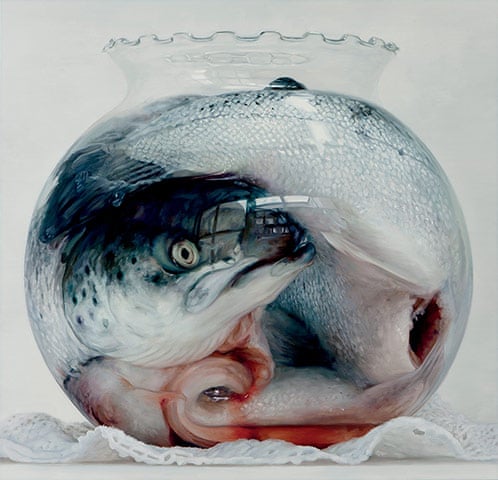
The two examples of still life including a fish which I chose to use are quite different from one another. The first is a photographic example which I found at The Guardian online.

the Guardian. (2019). The 10 best contemporary still lifes. [online] Available at: https://www.theguardian.com/culture/gallery/2013/oct/19/10-best-contemporary-still-lifes#img-10 [Accessed 17 Jul. 2019].

wright, c. (2010). Nature Morte 2. [image] Available at: https://www.theguardian.com/culture/gallery/2013/oct/19/10-best-contemporary-still-lifes#img-10 [Accessed 17 Jul. 2019].

This artist (Cindy Wright) has created a series of images to remind people about the cost of eating meat. All this image reminds me of are the needless displays of aggressive veganism at locations like Turkey farms and in the meat section of supermarkets. If we all had to kill our own meat then a lot of people may well choose to become vegetarian, personally I think that would depend entirely on how hungry people became. Everyone should know where their food comes from but equally there’s no need to dress it up. Again I find that this is an arrangement of objects to make a point but not something that I consider to be art.

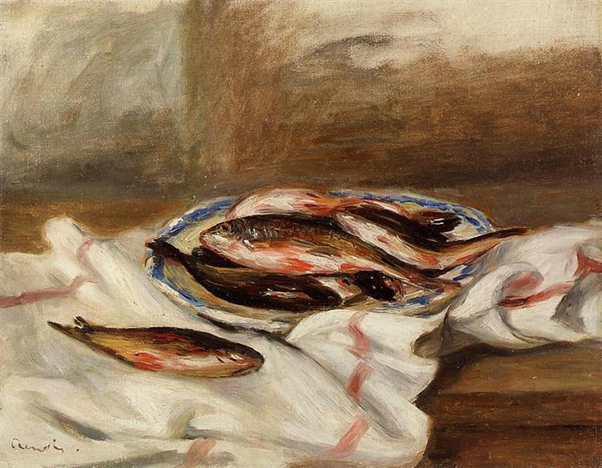
My second choice of still life is an impressionist oil painting called Still Life with Fish by Pierre Auguste Renoir from 1890 which I discovered at WikiArt online.

http://www.wikiart.org. (2019). Still Life with Fish, c.1890 – Pierre-Auguste Renoir – WikiArt.org. [online] Available at: https://www.wikiart.org/en/pierre-auguste-renoir/still-life-with-fish [Accessed 17 Jul. 2019].

Renoir, P. (n.d.). [image] Available at: https://www.wikiart.org/en/pierre-auguste-renoir/still-life-with-fish [Accessed 17 Jul. 2019].

I do not think there are any hidden meanings in this image, I believe that it has been produced purely for decorative purposes. This, to me, is an example of art. It serves a purpose and it took a lot of skill to complete.

I now have to watch a video discussion from the Khan Academy about Hirsts piece. I am to list the different areas of context that are covered and any references to ‘time’.

I found this video, not at the link given in the student handout but instead at https://www.khanacademy.org/humanities/global-culture/beginners-guide-contemporary-art1/v/hirst-s-shark-interpreting-contemporary-art

Khan Academy. (2019). Damien Hirst, The Physical Impossibility of Death in the Mind of Someone Living. [online] Available at: https://www.khanacademy.org/humanities/global-culture/beginners-guide-contemporary-art1/v/hirst-s-shark-interpreting-contemporary-art [Accessed 17 Jul. 2019].

Areas of Context;

  • The title of the piece
  • Arts relationship to the understanding of mortality
  • Physical construction of the artwork
  • How open to interpretation art from the 20th and 21st century is
  • Survival instinct of the human brain
  • The disintegrating nature of the shark and how that can be a metaphor for normal life
  • The impermanence of art
  • The sophistication of Damien Hirst and the potential thought he put into the design of the piece
  • The establishment of museums of philosophy

References to Time;

  • favourite piece of art in last 3-4 decades
  • the history or art coming to terms with mortality
  • art through history
  • 20th and 21st century compared to renaissance
  • post the movie ‘Jaws’
  • 2nd shark that has been displayed in this tank
  • “his design didnt hold up to time”
  • transgenerational nature of art
  • art changing over time
  • Egyptians mummifying bodies
  • the inevitability of decay
  • museums as time capsules

Whilst listening I was also to listen out for information on several other headings;

  1. Hirst – It is decided that it was Hirsts ‘sophistication’ that led to him choosing to display the shark in a tank of formaldehyde. ‘He created the impossibility of its preservation’.
  2. The Piece – The title of the piece is remarked upon as being just as profound as the piece itself. The full experience is described as including both the piece AND the title.
  3. Hirsts other work – It is mentioned that he also slices sheep in half and displays them in tanks.
  4. Information on other artists whose work is concerned with mortality -Duchamp is quoted as saying “A work of art is completed by the viewer”. No other artists are mentioned.

Has the contextual information about The Physical Impossibility of Death in the Mind of Someone Living altered your view or response to it in any way?

Yes it has. My initial response to this installation was exasperation. Having read further online in essays previously referenced about the links between Hirst’s shark and capitalism through the decades I can now see how it represents a many layered message. I’ll certainly never be able to watch ‘Jaws’ in the same way again!

Even with my further enlightenment I still have not changed my definition on what makes something art. Having to go and research something to understand it, in my opinion, means something is unsuccessful as a concept.

The Guardian Article

I located this at https://www.theguardian.com/artanddesign/2012/apr/02/damien-hirst-tate-review.

Searle, A. (2019). Damien Hirst – review. [online] the Guardian. Available at: https://www.theguardian.com/artanddesign/2012/apr/02/damien-hirst-tate-review [Accessed 17 Jul. 2019].

Well I’ve read the article and I’m firmly on the side of the author. When I read that he had been classing Hirsts work as ‘memento mori in the pursuit of a reputation’ since 2009 I actually laughed aloud. I couldn’t agree more.

He assembles objects which provoke a reaction, yes. Unfortunately that reaction is normally one of disgust. Is it necessary to continually present once living things in tanks of formaldehyde? I am currently sat in the Falkland Islands where I am being forced to work with the Army. One of their favourite games at the moment is to try and poo on the floor in as public a place as possible without being caught. Seeing this mornings turd outside the hairdressers provoked a reaction in me all right but it certainly doesn’t make it art.