I actually really enjoyed Assignment Five. Initially I struggled with locating a suitable textile to use as a subject piece, once I remembered about the existence of decades of strong national textile heritage it became a lot easier!
William Morris is a name I have heard bandied about for years on and off. I never really paid much attention bar the occasional eyebrow raising encounter with one of his incredible designs. It was fascinating to finally learn about his creative endeavours and life story.
The essay writing itself felt a lot easier than previous assignments, it was a case of trying to cut down on my typing rather than dredging up ideas to fill up a word count.
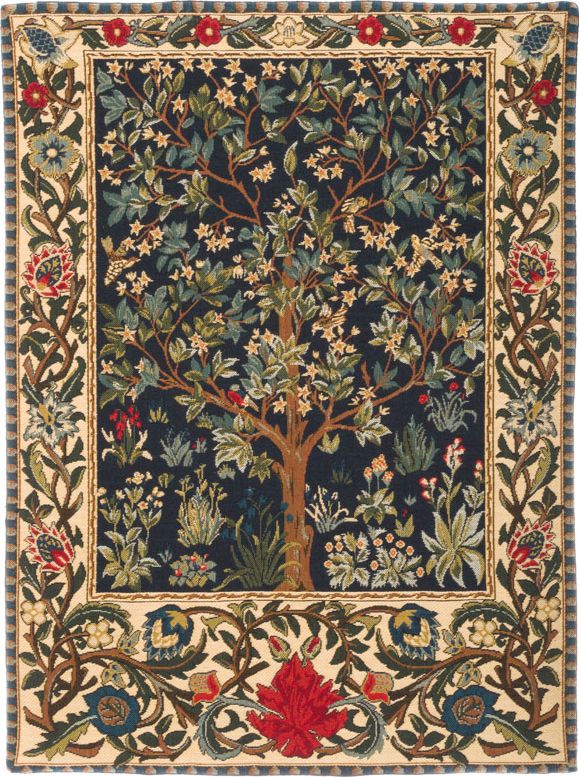
Looking at Morris’s work made me realise that quite a few artworks I have seen in films are inspired by him. One which stood out to me is below, the tapestry of the tree which in turn reminded me of the Black Family Tree from the Potter franchise.
It could be the similarity in the colour palette or simply the idea of a tree depicted in tapestry. Looking at it now I see simlarities in the sweeping lines of the leaves and branches of the two different pieces. Writing this has just given me an idea for the first exercise in Graphics 1….double win!
Overall, textiles has been an interesting module. I have learnt more from this module than the other four particularly about the wasteful nature of the fashion industry, that was eye opening. It was also encouraging to learn that artists such as Donna Wilson are able to find success with turning craft into business, and maintain the positive ethic values of that ideal throughout her operation.
My favourite exercise, besides the assignment, was in Part 1 in learning about the material life cycle. I learnt a lot from researching this area and will pay a lot more attention to where my clothes come from in future.
The exercise I found least enjoyable was researching Christian Boltanski’s installation ‘Personnes’ at the Grand Palais in Paris. Whilst I am aware that this will have been thought provoking and intriguing for many people, it’s just too morbid for my taste.
I would recommend this module to people who have no idea which specialised subjects they wish to study, also to those who are keen to learn more about thinking critically in relation to art. I would not recommend it to anyone with an engineering brain or who has low tolerance for understanding philosophical debate. I have learnt a lot from this module, my horizons have broadened and tolerance threshold has definitely increased, but I cannot honestly say I wouldn’t run away screaming if someone offered me a folder entitled Creative Arts 2.
In this exercise I am to find out about Christian Boltanski’s 2010 installation ‘Personnes’ at the Grand Palais, Paris and analyse it using the terms set out at the start of Project 3.
I am to read the critics reviews of the work and then answer the following questions;
In addition to the garments, the noise of the heartbeats permeates the exhibition. Why do you think this might be?
To what extent are the textiles transformed into something other than fabric?
Whats the significance of the installation title – and of the mechanical grabber?
What associations does this work conjure up in your mind?
My first step was to remind myself of the terms set out at the start of Project 3. These were the pairs of words; Art or Design, Temporary or Permanent, Large Scale or Small Scale, Transforming and/or Defining and/or Forming, Immersive and/or Distant, Pattern and/or Colour and/or Repetition and/or Shape.
I then looked at several critical reviews online, beginning with the Guardian article by Laura Cumming.
First response from reading the article – Good Grief. Coming at this exercise straight from the Christmas celebration is like having a bucket of cold water thrown over my head. What an incredibly morbid presentation.
Looking at the exhibit it reminds me, strangely, of Nazi death camps. The heaps of abandoned clothing represent the people that have passed through the area and no longer need them, the mass of neat squares represent the endless identical huts that these people were trapped inside. Maybe its the neatness of the squares that reminds me of the stereotypical German efficiency? The echoing of the heartbeat around the railway station is a reminder of the people who are not there, that their clothes are all that represents the life that used to be present. Maybe those clothes are cold, maybe they are still warm to the touch.
I then looked for other reviews online and was quite amused to find one in the Financial Times which talks about how Boltanskis father was actually a Jew who lived under floorboards! Maybe my initial impression is not as far off as I thought! According to the article ‘ the knowledge of this living entombment, this death-in-life, as well as the fate of millions of other European Jews, has informed all of his work as an artist’.
In this interview Boltanski talks about how he wanted to make a piece about ‘the finger of God’ and how Personnes is a ‘metaphor for chance’. He likens it to representing Dantes circles of hell and talks about how he collects heartbeats and has over 35,000 of them at home. The general message I get from this video is that the exhibition shows the fleeting nature of existence. Clothes and buildings get left behind for years, even heartbeats can be preserved but the human body cannot. When someone is dead they are dead and it could happen to anybody at any time.
Returning to my intial brief I reflected on the terms set out at the start of Project 3 and applied them to Boltanskis exhibition.
In addition to the garments, the noise of the heartbeats permeates the exhibition. Why do you think this might be?
I think the use of recorded heartbeats makes the exhibition immersive as opposed to just visual. By filling the (very pretty) railway station with sound you are making the building itself part of the exhibition as opposed to merely the staging area for it.
The heartbeats are another reminder of the fleeting nature of existence, a reminder of how a heartbeat can be collected and recorded but a human once gone is gone forever.
To what extent are the textiles transformed into something other than fabric?
With this question I’m assuming it means what does it remind me of? What do the clothes represent? They remind me, as per my initial impression, of dead people. My first impression was of Nazi death camps, and the more I have read about this exhibition, also of homelessness. I think this latter representation is because of the bags of clothes that I take to charity shops..? It is the formation of the clothes into the neat squares which gives the impression of the death camps.
Whats the significance of the installation title – and of the mechanical grabber?
The installation title ‘personnes’ means both somebody and nobody in French. This is another reference to the idea that the exhibition is about the fleeting nature of existence, Boltanskis ‘finger of God’. Nobody is present there currently but someobody once wore those clothes, somebody once owned that heartbeat.
The mechanical grabber and its pyramid of clothes remind me more of landfill or the wasteful processes of the fashion industry than of the transient nature of life.
What associations does this work conjure up in your mind?
Nazi death camps
Landfill
Wasteful fashion industry practices
That scene in Toy Story when a Minion gets chosen by ‘The Claw’….
In this exercise I am to examine knitting. I am first to create a mind map (1) of what knitting means to me and what I associate with it. I am then to do some visual research (2) by finding contemporary and historical examples of knitting being represented. I am then to see how the examples of knitting that I’ve found support or contradict the associations identified in my mind map (3). I am then to see if there is a general stereotype of knitting and how have contemporary images of knitting played with this stereotype (4).
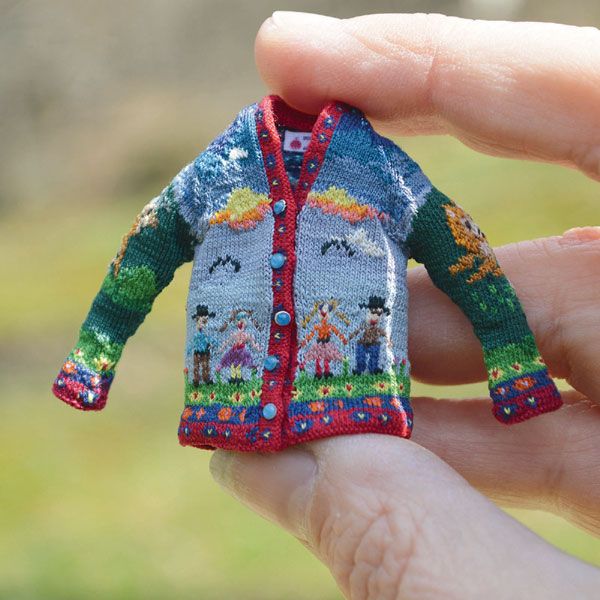
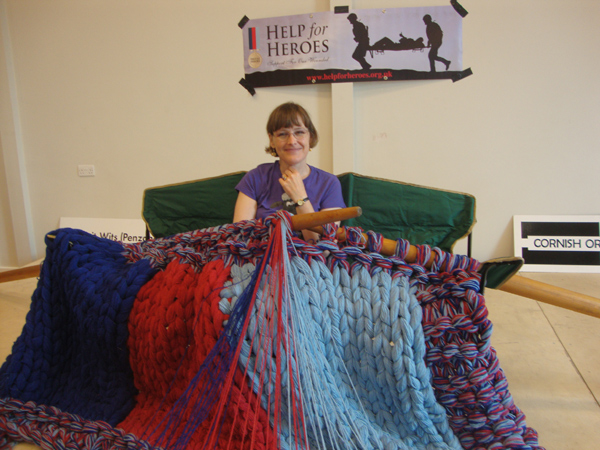
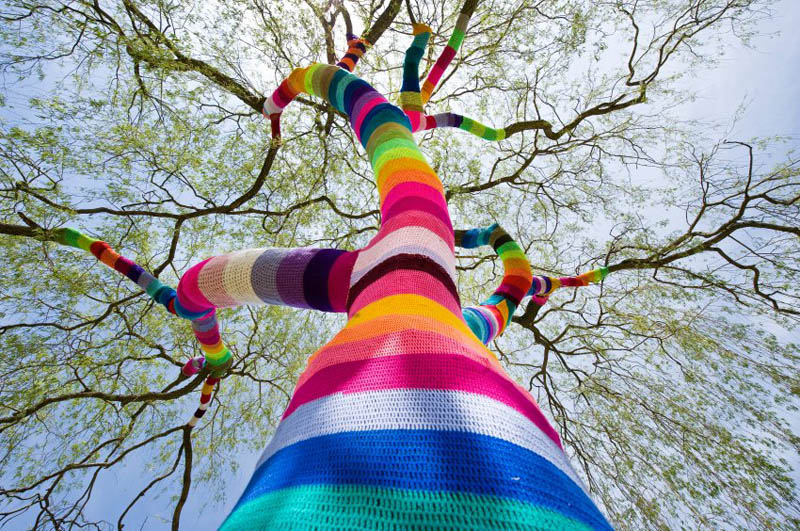
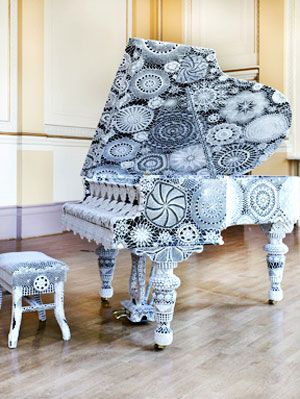
Mind Map I first brainstormed everything I could think of to do with knitting. I immediatly came up with the stereotype of old ladies sitting around knitting and churning out scarves, gloves, jumpers etc. I then thought of different types of knitter that I had seen. A Scouse friend of mine used to bring her knitting into work and do it during tea breaks when she was feeling stressed (the needles were a blur and she would swear profusely the entire time but she always felt better afterwards), a lady on Dragons Den submitted a pitch for giant yarn and giant knitting needles. Last year I went to Bowood House craft fair (Kirsty Allsop event) and there were knitted covers on lamp shades, lamp posts and everything inbetween. I guessed that there might be cases of extrmee knitting and sure enough I discovered both the incredibly small and the oversized. This soon morphed into (2) find contemporary and historic examples.
What is yarnbombing? ” the action or activity of covering objects or structures in public places with decorative knitted or crotcheted material, as a form of street art”
( Dictionary.com. (2019). Dictionary.com Is The World’s Favorite Online Dictionary. [online] Available at: https://www.dictionary.com/ [Accessed 26 Aug. 2019].)
Knitting as street art?! Surely not!…….but how wrong I was…
Ive always thought of knitting as a womens activity as traditionally we have been the ones to stay at home. I’ve found a picture reference which backed up that point and made me laugh quite a lot. It doesnt get any more ‘female in the home’ than Mary the mother of Jesus pictured knitting in a painting created in the 1350’s.
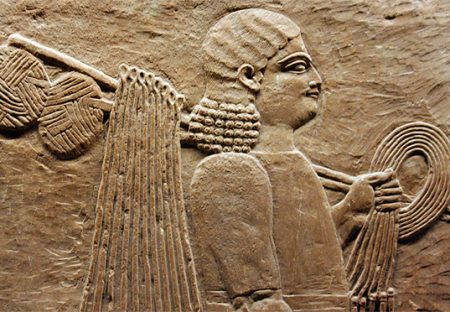
I initially started looking for the earliest trace of knitting. Every book or art starts with a cave painting of something and sure enough I found a photo of what looks like knitting in an Egyptian looking stone carving. I was quite excited to read more about this on the website I discovered it on, unfortunately though they do not seem to know anything about the picture themselves, it isn’t mentioned at all in the text. I’ve included it as a point of interest.
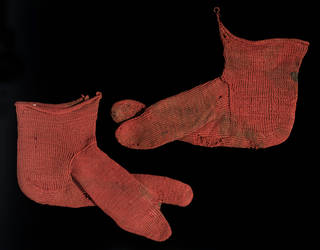
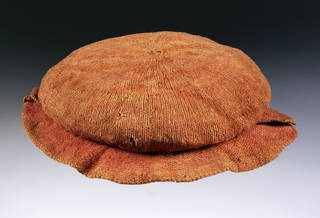
This is the Vand A’s earliest example of knitting. It is a pair of socks from Egypt dating from around the 3rd to 5th century AD.
Knitting was recognised and protected as a trade in England from an early age. In 1571 the cappers act was past which enforced the wearing of caps for most common people on every Sunday and holiday “a Cap of Wool knit, thicked and dressed in England, made within this Realm, and only dressed and finished by some of the Trade of Cappers, upon pain to forfeit for every Day of not wearing three Shillings four Pence”
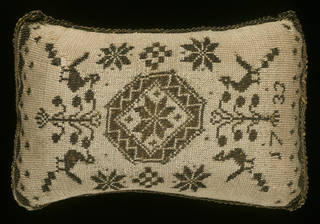
In the 18th century knitting became a pasttime of wealthy ladies who had the hours to spend learning to knit properly. It soon became a ladies ‘skill’ such as singing and playing the piano. The creation of fancy items became a widely accepted way of demonstrating ones taste and skill level.
As knitting became more well known it was adopted by sailors and fishermen as a way of creating garments to keep themselves warm, around this time the cable stitch was developed which added bulk and warmth to the items.
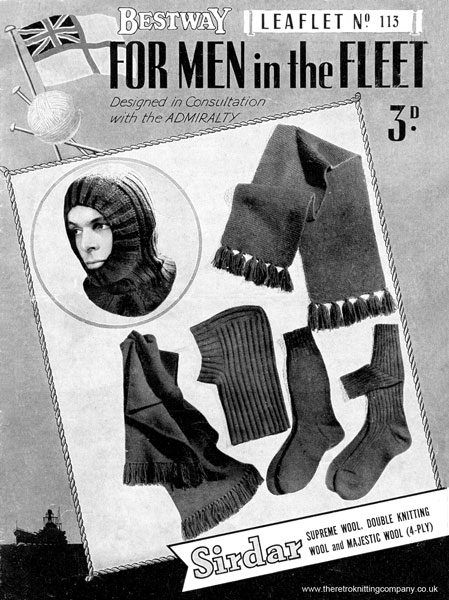
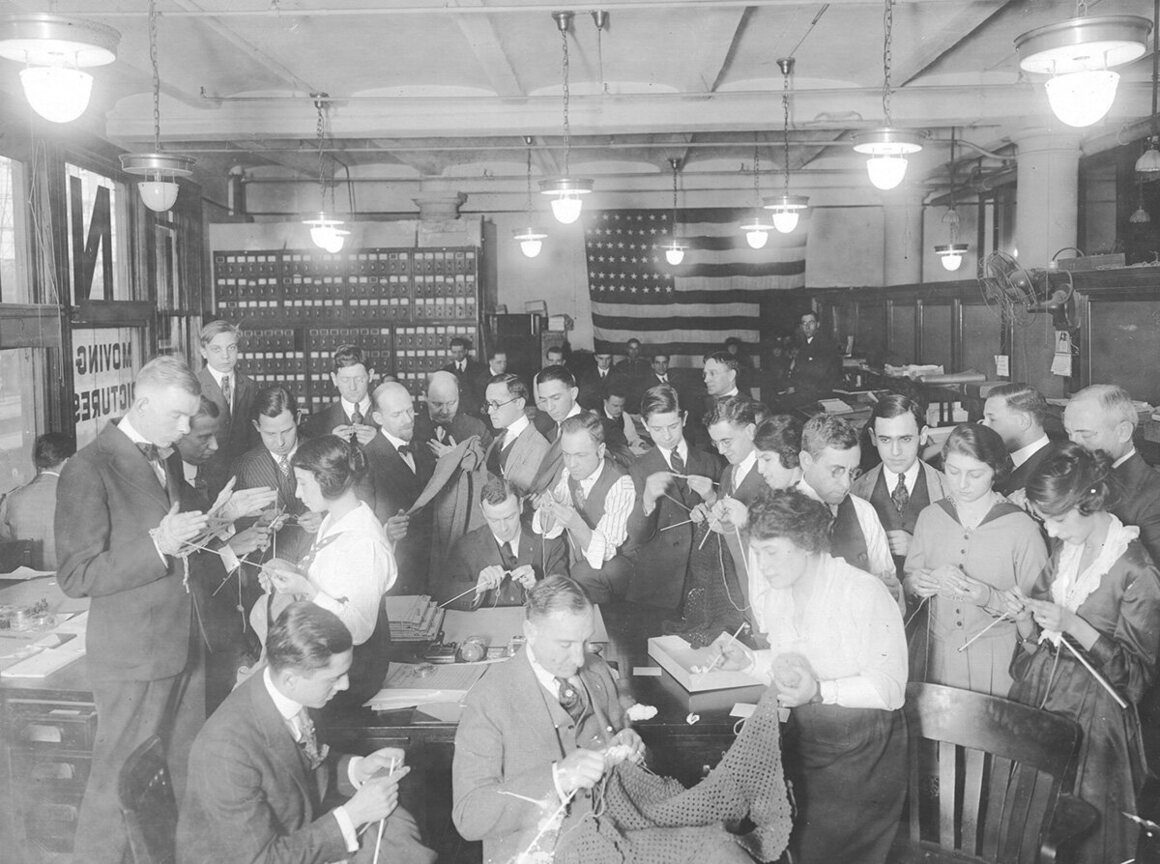
In the First World War people were encouraged to knit items to keep the soldiers in the trenches warm. Again in the second world war with wool in short supply people were encouraged to recycle with knitting, picking apart old jumpers to make new ones.
3. Looking at the stereotypes which I came up with from my initial mind map and the actual history of knitting, they are worlds apart. Whereas I was under the impression that knitting was something that only old people did when they were less mobile and had more time on their hands, it is in fact something that people have done for thousands of years. Its an economical way to generate clothing and provide garments with added warmth to those who may need them. I particularly enjoyed learning about how during World War Two people used to unpick old jumpers to recycle the wool and knit new ones. Everything I have learnt in my research absolutely contradicts the associations identified in my mind map.
4. There is definitely a general stereotype of knitting as being associated with old people. I think this is because those who are in their 60’s now were probably the last generation to use knitting as a necessity. I have parents in their 60s and they both have tales of knitted swimming costumes. Thanks to the internet and a new interest in all things craft, knitting is becoming more well known again. New interest in it as a hobby is awakening. I think that if the same question were to be asked in another 10-15 years the answer would be that Knitting is something craft loving people do. I for one hope that it will be around for a long time to come.
In this exercise I am to look at the set textbook pages 80-82 and write down the signifier and the signified of such images. I am then to take note of where these phenomena are formed and their relationship to the land.
Signifier – the form a sign takes : Flattened corn in a stylised pattern
Signified – the concept to which it represents or refers : Crop circles in Wiltshire “traditionally the home of paganism and New Age mythology” refer to an unexplained relationship between the land and possibly paranormal forces.
I remember the early 90’s when mystery crop circles were all over the news. It seems a shame that artists owned up to making them and although taking the credit, also ruining the sense of mystery. This has not put people off attempting to ‘prove’ that crop circles are made by aliens, I found one BBC report (http://news.bbc.co.uk/1/hi/uk/2191565.stm ) in which a crop circle artist states that he has been told crop circle artists are part of a cover-up by the Government, even though he himself has confessed to making them in the first place.
I think crop circles are class, they give people a sense of wonder and fire up imaginations in a way in which a lot of things often fail to do when you become buried in the humdrum of adult life.
They are most often found in wheat fields because wheat when bent gives the sharpest edge to enable artists to create the crispest lines. They are most often created down in South West England where tales of folk lore are the strongest. They are often located on ley-lines, or lines of energy believed to be within the land itself.
For this exercise I am to use images of apples as a starting point. I am to think about what the image of an apple could represent or signify, placing recognisable images in contrast to others in order to generate new meanings or to reveal critique or satirise exisiting images and the ideas represented in those images in some way.
In this image by Rene Magritte ‘The Son of Man’ the apple is being used as a form of disguise. Magritte is supposed to have said about this painting “… It’s something that happens constantly. Everything we see hides another thing, we always want to see what is hidden by what we see.” In this context the apple is being used to hide the face of the man and to make the viewer curious about what it is concealing.
In this image the apples are being used as a complimentary item of a summer scene. Collecting apples in the orchard is something which is quintessentially English, it evokes images of summer days and English summers in green fields with blue skies. In this image apples are a decorative addition.
This stained glass window depicts the apple in the most traditional context used by art. Eve eating the apple from the forbidden tree in the Garden of Eden and so causing herself and Adam to be cast out is an image of temptation which is still used heavily today.
What does this apple mean? Temptation
Cookson, G. (2019). The story behind Apple’s iconic logo – Hotfoot Design. [online] Specialist Web Design and Brand Agency in Lancaster, Lancashire | Hotfoot Design. Available at: https://www.hotfootdesign.co.uk/white-space/apple-iconic-logo/ [Accessed 26 Aug. 2019].
This image of the apple is used by technology giant Apple. It is on every piece of technology they produce and has become so widely recognised that no text addition is required to make it recognisable as what it is. There are urban myths that the bite out of the apple was added in as a nod to Alan Turing who was a famous code breaker during World War Two who worked at Bletchley Park. Persecuted for being homosexual he died eating an apple infused with cyanide at the age of 41. Interestingly the article which I found this image on states that the designer actually added the bite out of the apple to stop it from looking like any other round fruit.
This image of an apple is being used to reinforce the impression of health and wellbeing. This company is attempting to promote the angle that it a health insurer of a baseball team called the Indians. Using an apple, the subject of such phrases as “an apple a day keeps the doctor away” instantly creates the desired association in the eyes of the viewer.
In this exercise I am to re-write a few lines of the extract from ‘The Road’ using different types of narrator.
Original – He pushed the cart and both he and the boy carried knapsacks. In the knapsacks were essential things in case they had to abandon the cart and make a run for it. Clamped to the handle of the cart was a chrome motorcycle mirror that he used to watch the road behind them.
First Person – I pushed the cart. The boy and I both carried knapsacks, the straps cutting into our shoulders. We couldn’t lighten them, they contained the essential things we would need in case we had to abandon the cart and make a run for it. Clamped to the handle of the cart was a chrome motorcycle mirror we had salvaged. I kept one eye on it, the road behind us. The handles were heavy in my sweaty palms, with tired arms I lowered my head and pushed on.
Second Person – You pushed the cart and both you and the boy carry knapsacks. In the knapsacks are essential things in case you have to abandon the cart and make a run for it. Clamped to the handle of the cart is a chrome motorcycle mirror that you use to watch the road behind you.
If McCarthy had chosen the third person limited point of view, think about the difference between telling the story from the boys POV or the mans.
If McCarthy had chosen a third person limited point of view then he would only have been able to tell us the thoughts and feelings of one character. For this to work well he would have had to focus on just one character throughout the story as opposed to giving the pair equal importance. It would also mean that the relationship between the two could not be fully explored, there are two sides to every story!
What impact does changing the narrator have on the story? Why do you think McCarthy chose to use an omniscient narrator?
I think the ability of the omniscient narrator to know and see everything gives a lot of stories a significant advantage. It gives the author more options in exploring relationships and interplay between the characters making them more multi-faceted.
In this initial extract it also provides more mood. The reader does not know anything else about these characters, not even their names. The only information that we have is their setting, because of this, this is what we focus on. We start to wonder about their circumstances, whay are they in the position that we find them in? What are they running from or too?
My first task within this project is to read chapter ‘Room Seven: Itinerancy’ of the course set textbook with focus on the ‘Cucumber Journey’. I am to examine how time, place and journey have an impact on the work.
Firstly,
even after having completed the initial module on contemporary art, I do not
see how pickling vegetables whilst travelling on a canal is art. I just can’t
wrap my head around it. Seriously, is this one of those questions that they
post in newspapers as recruitment advertisements for Mi5?
The last line on page 156 summed up for me
the ludicrous nature of this as an item of art, ‘the pickles will begin a new
journey in peoples bodies’. There is probably a school of thought that as the
pickle is broken down by the bodies enzymes and turned into kinetic energy that
we use that energy to plant crops of new cucumbers and so a cycle of life is
complete. There is also a school of thought that the Earth is flat and magic is
real, but, I will try…
Time is of relevance to this piece because
with the passing of time not only the location but the form of vegetable itself
changes. As the canal boat travels from London to Birmingham so the cucumber
travels from a fresh state to a pickled one. This is reminiscent of how people
travel through life, fresh and ‘green’ as described by Dylan Thomas in ‘Fern
Hill’ , and, with the passing of time as they complete lifes journey, they
slowly pickle in a marinade of experience and outside influence until they die
and are returned to the soil. (To fertilise new crops of cucumbers I have no
doubt…). One could argue that if a pickled cucumber is what exists when the
canal boat reaches Birmingham, was there ever a fresh cucumber in London? With
each passing moment the cucumber steadily ages, in this case in an artificially
speeded up process. This could be seen as a reflection of society today. We
live in a consumerist culture where companies are concerned only about making
money and stress related mental health issues are at their peak, are we all
being pickled in the vinegar of our everyday lives?
The only way I can see that Place would be of relevance
is to reiterate that in each location the cucumber was in a different form? In
London it was a fresh vegetable, in Birmingham it was a cucumber. During the
journey of the canal boat so too was taking place the journey of the cucumber?
Exercise 1 – Choose a novel or a film or a play you love and map it to The Hero’s Journey
I have chosen to use another J.K Rowling
creation as I know it quite well, I would have chosen Harry Potter if the course
textbook hadn’t used it as an example!
Fantastic Beasts and Where to Find Them
Act 1
Endangered animal enthusiast and lone
wizard, Newt Scamander, The Hero, arrives in New York with a suitcase full of
creatures. He travels the world saving endangered animals, restoring them back
to their natural environments and gently educating his fellow wizards about
them. Carrying out this vocation is hisOrdinary World.
Newt receives his Call To Adventureon the steps of the bank at which the Salem League is
protesting against witches. He is asked if he is a seeker after truth, he is
further asked to comment on the idea that witches live amongst the normal
humans. Newt refuses to answer and makes a hasty exit in pursuit of one of his
escaped creatures. This refusal to interact is Newts Refusal Of The Call.
Inside
the bank he meets Tina Goldstien (Meeting with the Mentor)
who will be Newts guide to wizarding America. He is arrested by Goldstien and
taken into MACUSA, Crossing TheFirst Thresholdtowards interacting with other wizards,
not just animals.
Act 2
As Newt, Jacob and Goldstien travel New
York recapturing his escaped creatures their paths begin to cross with MACUSA’s
Augustus Graves. Tests Allies and Enemies.
In his Approach To The Inmost Circle, Newt is
questioned by Graves who inadvertently starts to show signs of nefarious
intent.
When Creedence is revealed both as the Obscurous and as a scared boy,
Newt tries to save him both from self destruction and from the plotting of
Graves who wishes to use Creedence as a weapon. Battling Graves for Creedence’s
heart is Newts Ordeal.
Towards the end of the battle, Newt is losing and will be killed.
Creedence intervenes to save him from Graves and at Newts urging, shows mercy.
The saving of Creedence’s soul is Newts initial Reward.
Graves is unveiled as villain Grindewald further rehabilitating Newt in the
eyes of MACUSA.
Act 3
The Road Backfor Newt begins with the thanks of the American MACUSA
President. He is able to use one of his creatures to wipe the memory of the
city thereby enabling the Resurrectionof the magical worlds shroud of
secrecy.
He Returns (to the UK) with the Elixir of the promise of new love.
I am now to use the same stages of A Heroes Journey to create my own story.
Act 1
Ordinary
World – A shy bear who is scared of going outside, lives in a playroom.
He
likes watching planes through the window, sits in a plane and imagines flying.
Call
To Adventure – Invited to a toys picnic in the garden
Refusal
of the Call – Says no because scared of outside and
doesn’t really know anybody.
Meeting
with the Mentor – He meets Bolt the rabbit engineer. Mad
Scientist.
Crossing
the First Threshold – Leaves his shelf for first time, into
Bolts workshop, helps him with inventions?
Act 2
Tests/Allies/Enemies
Meets Captain Cassidy and his men (toy
soldiers) who go hunting for bits and pieces for Bolt. In exchange Bolt fixes
their tanks/rifles/catapults/bodyparts. The soldiers look a bit like worker
ants when they drag back the assorted parts.
Sees The Cat (enemy) who tries to catch
the soldiers and their loot
Bear is brave and chases the cat away
Gets picked up by The Dog and dropped in
the garden – realises it’s a nice place full of sunshine and flowers – nothing
to be scared of
Approach
to the Inmost Circle – Toys picnic gets chased off by cat, cat
eats sandwiches. Bear deploys in Bolts plane with Captain Cassidys men,
airdrops soldiers to secure picnic area
Ordeal
– Plane breaks, too much weight, Bear parachutes out of
plane with picnic, as ‘outside’ as outside can be
Reward
– Saves the picnic, lands to a heros welcome, realises
everyone likes him
Act 3
The
Road Back – Toys get found in garden by child, put in cart and
taken back inside….literally giving them a lift
Resurrection
– New life as Bolts test pilot
Return
With the Elixir – No longer scared of outside, dreams of
flying now real, lots of new friends
My notes on –Lecture One. Playing to the Gallery: Democracy Has Bad Taste
Contemporary art, once a bit of an eccentric niche, has gone mainstream, it’s all around us. A lot of people still aren’t comfortable with the idea of modern art and need more of a frame of reference with which to approach it which is what Grayson Perry (GP) wished to address.
There is a somewhat backward relationship between what we are told is good and what is actually popular. What is popular is different again to what we think we want, this was demonstrated by the experimentation of Komar and Melanie in the 1990’s. Currently something is only judged to be ‘of quality’ if deemed so by a range of different people from the artists peers to critics and dealers. After these inspections have taken place we are allowed to approach the ‘art’ knowing that this must be good. To me that defies the whole point of art, what’s right for one person is not right for another, if you happen to be in a minority of people for liking something then why should this mean that it is worth less, if, for you, it still takes your breath away?
Art takes itself very seriously as GP discovered when he was asked if he was a loveable character or a serious artist. The impression that the art world gives off is that you have to be high brow or your work is not worth as much, why? One example that springs to my mind is Banksy, an artist who regularly makes political statments through the use of representational elements in a very contemporary medium, admittedly a little illegally. His paintings are protected and auctioned for thousands which implies that he has passed the inspection phase that GP mentions by the curators, collectors and peers. Still though I do not see him feted in the art world for his talent, from what I have seen so far he seems to be an artist recognised and celebrated by the people rather than the experts.
This made me think twice about the title that GP gave this initial lecture. ‘Democracy has Bad Taste’. Does he mean that we, the great unwashed, have got no taste in what is art and what is not? Quite possibly it is instead a reference to the fact that what is deemed to be good by the experts can be at odds with what is actually popular. GP is a bit of an enigma in this interview both poking fun at the art worlds seriousness whilst simultaneously shuddering at the thought of fashionable people deciding that they like his art so I’m not sure which definition he would have been leaning towards.
In 1998 I watched the Turner Prize as recommended by my Art Teacher at the time. The winner that year was a man called Chris Ofili who uses a lot of elephant dung in his work to either adorn or support his paintings. Elephant dung. Now this guy must be classed as a good artist, he attended the Chelsea School of Art followed by the Royal College of Art in which time he was awarded a travelling scholarship around Zimbabwe (https://www.tate.org.uk/whats-on/tate-britain/exhibition/turner-prize-1998/turner-prize-1998-artists-chris-ofili Accessed 20/02/19) . On top of all that, he didn’t pull that Turner prize out of a cereal packet, he won it fair and square. It is the ‘how!?’ that blows my mind.
He’s attached poo to the painting of a black woman. If anybody else on the planet did that right now there would be outpourings of accusations of either racism or gender inequality. On top of that the painting doesn’t even look that good, to me, but as I’m sure is coming across I am one of the Great Unwashed who has no ‘taste’ in art and thinks Banksy is an inspiration. If that means I never have to look at a painting covered in elephant poo and look for deep significance within it then I’m ok with that to be honest!
Lecture Two. Playing to the Gallery: Beating the Bounds
Within this lecture GP sets out a criteria to help people decide whether or not something is art.
He also mentions an artist called Marcel Duchamp who brought a urinal into an independent art gallery in 1917 . Duchamp (GP says) believed that he could just point at something and say “That’s art”. I can’t believe that there was not a single person there who said to him “No mate, that is a urinal”, writing your name on something does not make it special. GP mentions further examples such as an artist (Robert Rauschenberg) who was asked to paint a portrait to which he wrote a response claiming an approximation of “this is a portrait if I say it is”, and this GP alleges is another work of art. No Mr Perry, that is someone being a tit.
As if his examples could not get any more hair-pullingly frustrating for their utter lack of hand skill, once again we are drawn back to excrement. It seems in 1961 an artist called Piero Manzoni canned his own faeces and sold them for their equivalent weight in gold.
*head in hands*
I listened to GP’s different litmus tests of whether or not something is a piece of art and came to the conclusion that he is actually one of the establishment of people he claims to poke fun at from afar.
Only one thing he mentioned in his lecture had any resonance with me. It was something he was told by Charlie Gere, Professor of Media Theory and History at Lancaster University. GP asked him ‘Can you give me a definition when I would know I was looking at a piece of web art rather than just an interesting website’. The reply was ‘you know it might be art rather than just an interesting website when it has the grip of porn without the possibility of consummation or a happy ending’. Now, ignoring the (once again) overly sordid frame of reference and applying it to art in general, that is the closest definition that I have found so far that correlates with my own opinion of what is and is not art.










 Creative Arts Today